


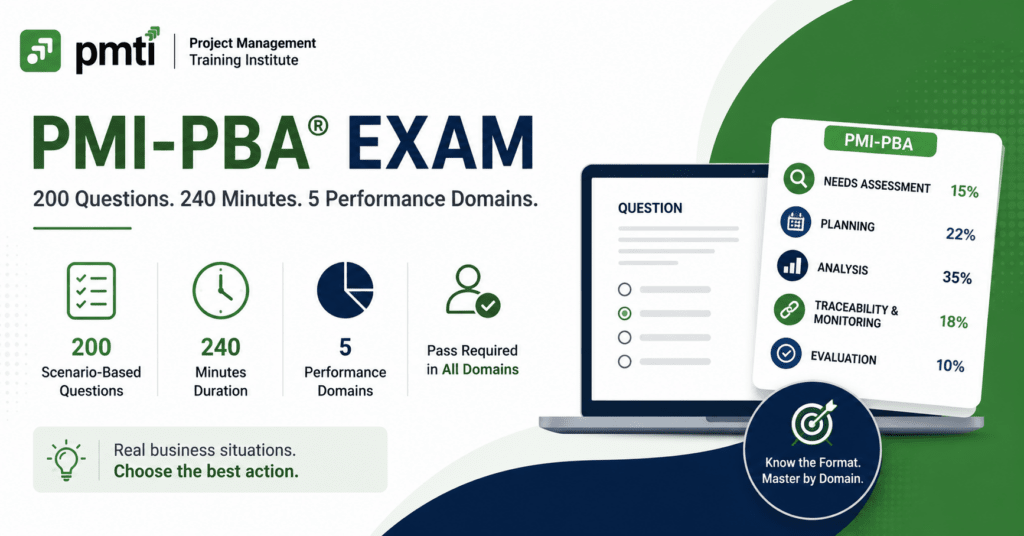

The PMI-PBA exam contains 200 scenario-based questions completed in 240 minutes across 5 performance domains: Needs Assessment, Planning, Analysis, Traceability and Monitoring, and Evaluation. Every question presents a real business analysis situation — candidates select the best action, not the textbook definition. The Analysis domain carries the highest weight at 35% of exam content (~70 questions), followed by Planning at 22% (~44 questions). No single domain can be skipped — PMI reports results at the domain level and requires passing performance across all 5. This guide explains the exam question format, shows 10 original sample questions with full answer explanations, and covers how to build practice exam readiness by domain.
What Type of Questions Appear on the PMI-PBA Exam?<br>
The PMI-PBA exam uses scenario-based questions that test applied business analysis judgment — not term definitions. Every question presents a project situation with 4 answer options that are all plausible. Candidates select the action that best aligns with PMI’s business analysis standards and the situation context.
3 question characteristics define PMI-PBA difficulty:
All 4 options are defensible. PMI constructs distractors that represent real actions a business analyst might take in practice. Candidates who rely on instinct or real-world habit rather than PMI’s preferred approach consistently select plausible but incorrect answers.
Questions test sequence and priority, not just knowledge. A significant proportion of questions ask what the BA should do first or next — testing understanding of the correct order of business analysis activities, not just whether the candidate knows what each activity involves.
Domain context determines the correct answer. The same business analysis action may be correct in one domain context and incorrect in another. A candidate who understands which domain governs a scenario — Needs Assessment, Planning, Analysis, Traceability, or Evaluation — answers more accurately than one who applies general knowledge without domain framing.
How Many Questions Are on the PMI-PBA Exam?
The PMI-PBA exam contains 200 total questions completed in 240 minutes (4 hours) through Pearson VUE. The average time per question is 72 seconds. PMI does not publish a numeric passing score — results report at the domain level across 4 proficiency ratings.
| Exam Attribute | Detail |
| Total Questions | 200 |
| Exam Duration | 240 minutes (4 hours) |
| Average Time Per Question | ~72 seconds |
| Delivery | Pearson VUE — test center or online proctored |
| Passing Score | Not published — domain-level proficiency ratings |
| Result Ratings | Above Target, Target, Below Target, Needs Improvement |
| Domains | 5 |
PMI does not identify which questions are experimental pretest items during the exam. Every question receives full effort. The 4-level proficiency rating system — Above Target, Target, Below Target, Needs Improvement — reports performance independently for each of the 5 domains. Target or Above Target in all 5 domains is required to pass.
How Are PMI-PBA Questions Distributed Across Domains?
The Analysis domain carries the highest PMI-PBA exam weight at 35% — approximately 70 of 200 questions. Planning at 22% and Needs Assessment at 18% are the next highest priorities. Traceability and Monitoring at 15% and Evaluation at 10% complete the distribution.
| Domain | Weight | Approx. Questions | Primary Focus |
| Needs Assessment | 18% | ~36 | Problem identification, stakeholder analysis, business goals |
| Planning | 22% | ~44 | Requirements approach, elicitation planning, stakeholder engagement |
| Analysis | 35% | ~70 | Elicitation, documentation, modeling, validation, prioritization |
| Traceability and Monitoring | 15% | ~30 | Requirements tracking, change management, traceability matrix |
| Evaluation | 10% | ~20 | Solution validation, business value measurement, transition support |
Study time allocation directly mirrors these weights. Analysis at 35% receives the largest preparation investment. Planning at 22% is the second-highest priority. Candidates who underestimate Needs Assessment at 18% — treating it as a brief introductory topic — leave 36 questions underserved.
What Do PMI-PBA Questions Actually Test?

PMI-PBA questions test situational judgment across 5 business analysis competency areas: problem framing, requirements planning, requirements elicitation and analysis, traceability management, and solution evaluation. Questions test what a qualified business analyst does in a given project situation — not what terms mean.
4 reasoning patterns appear repeatedly across PMI-PBA questions:
Identify the correct sequence — Multiple actions are all valid, but only one is the correct first step. Example: A BA encounters conflicting stakeholder requirements. The question tests whether the candidate correctly identifies stakeholder analysis as the precursor to requirements negotiation.
Select the appropriate technique — Given a specific project context (Agile environment, large stakeholder group, regulatory compliance requirement), select the most appropriate elicitation, modeling, or traceability technique.
Apply PMI’s preferred professional standard — PMI has defined positions on how business analysts should handle scope changes, requirements conflicts, and stakeholder escalation. Candidates who apply their own organizational practices rather than PMI’s standard framework consistently select incorrect answers.
Evaluate solution performance — Evaluation domain questions test whether the BA can distinguish between a technically complete solution and a business-value-complete solution — and knows what to do when the two diverge.
PMI-PBA Sample Practice Questions
The 10 sample questions below are organized by domain to demonstrate the question style, difficulty calibration, and reasoning required across the full exam. Each answer includes a rationale that explains why the correct answer is right and why the 3 distractors are wrong.
Domain 1 — Needs Assessment (18%)
Question 1 A business analyst has been assigned to a new initiative. Three departments hold conflicting views on what business problem the initiative should address. What is the most effective first step?
A) Begin writing user stories based on each department’s stated needs B) Create the stakeholder communication plan C) Conduct a stakeholder analysis to understand each group’s interests, influence, and perspective on the business need D) Escalate the conflicting views to the PMO for resolution
Correct Answer: C Stakeholder analysis is the correct first step in Needs Assessment when stakeholders hold different perspectives on the problem. Writing user stories (A) before the problem is defined produces misaligned requirements. Creating a communication plan (B) is a Planning activity that follows Needs Assessment. Escalating to the PMO (D) bypasses the BA’s core responsibility to understand and reconcile stakeholder perspectives.
Question 2 A project sponsor has described a desired outcome but has not identified the root cause of the business problem the project should solve. What should the business analyst do first?
A) Begin eliciting requirements from stakeholders B) Create the requirements management plan C) Conduct a situation assessment to identify the root cause of the business problem D) Define the solution scope
Correct Answer: C Needs Assessment begins with identifying the root cause of the business problem before requirements work begins. Eliciting requirements (A) without understanding the problem produces requirements that solve the wrong issue. Creating a management plan (B) and defining solution scope (D) both depend on a defined business problem to be valid.
Domain 2 — Planning (22%)
Question 3 A business analyst is planning a requirements approach for a project with stakeholders who cannot fully articulate their needs upfront. Delivery will occur in 3-month increments. Which approach is most appropriate?
A) A fully predictive requirements specification completed at project initiation B) An iterative approach with progressive elaboration of requirements across increments C) A requirements freeze after the first stakeholder workshop D) A single requirements sign-off at the end of the final increment
Correct Answer: B When stakeholders cannot define requirements upfront and delivery is incremental, an iterative approach with progressive elaboration is most appropriate. A fully predictive specification (A) assumes requirements are fully knowable at the start — an incorrect assumption given the context. A requirements freeze (C) limits the BA’s ability to incorporate learning across increments. A single sign-off at the final increment (D) creates risk by deferring validation until it is too late to course-correct.
Question 4 A business analyst is developing the requirements management plan for a hybrid project — predictive for infrastructure and Agile for the application layer. Which factor most influences how the BA plans requirements elicitation?
A) The total project budget B) The number of stakeholders in the stakeholder register C) The delivery approach selected for each project component D) The project manager’s preferred documentation format
Correct Answer: C In a hybrid project, requirements planning must account for the different elicitation and documentation methods appropriate to each delivery approach. Infrastructure requirements may follow a detailed specification model; application requirements may use user stories and acceptance criteria. Budget (A) is a constraint, not a planning driver for elicitation method selection. Stakeholder count (B) affects planning scale but not elicitation approach. The PM’s documentation preference (D) does not determine how requirements are elicited.
Domain 3 — Analysis (35%)
Question 5 A business analyst is facilitating a requirements workshop. Two stakeholders have directly conflicting requirements — one requests automated approval and the other requires manual review for regulatory compliance. What is the most effective action?
A) Document both requirements and escalate to the project manager B) Accept the first stakeholder’s requirement as the higher priority C) Remove the conflicting requirement from the scope D) Facilitate a negotiation session to identify the underlying interests behind each position
Correct Answer: D Conflict between requirements requires the BA to identify the underlying interests driving each stakeholder’s position — not just the stated requirements. Escalating to the PM (A) transfers the BA’s analysis responsibility. Accepting one stakeholder’s position (B) without analysis risks delivering a non-compliant solution. Removing the requirement (C) eliminates business value without understanding whether resolution is possible.
Question 6 During requirements analysis, a BA discovers that a stakeholder’s stated requirement directly contradicts a regulatory compliance requirement. What should the BA do?
A) Document the stakeholder requirement as stated and flag it for review B) Replace the stakeholder requirement with the regulatory requirement without informing the stakeholder C) Defer the conflict to the testing phase for resolution D) Analyze the impact of both requirements, document the conflict, and facilitate resolution with the relevant stakeholders
Correct Answer: D Requirements conflicts with regulatory implications require analysis, documentation, and facilitated stakeholder resolution before implementation. Flagging without resolution (A) delays the problem. Replacing the requirement without informing the stakeholder (B) bypasses proper change management and stakeholder engagement. Deferring to testing (C) allows a compliance conflict to persist through design and build — significantly increasing remediation cost.
Question 7 A BA is validating requirements with the development team when the team identifies that 4 requirements are technically infeasible within current project constraints. What should the BA do?
A) Remove the infeasible requirements from the requirements baseline B) Escalate the technical concerns to the project manager to resolve with the development team C) Accept the team’s assessment and inform the sponsor that scope must be reduced D) Document the technical concerns, facilitate a solution options analysis, and present alternatives to stakeholders for a decision
Correct Answer: D Technical feasibility concerns require the BA to document the issue, facilitate analysis of alternatives, and present options to stakeholders for an informed decision. Removing requirements unilaterally (A) bypasses stakeholder authority. Escalating without analysis (B) transfers the problem without adding BA value. Accepting reduced scope without exploring alternatives (C) limits the decision-maker’s options unnecessarily.
Domain 4 — Traceability and Monitoring (15%)
Question 8 A project team is 60% through development when a stakeholder requests a significant change to a core business requirement. What should the business analyst do first?
A) Accept the change and update the requirements documentation immediately B) Reject the change because development is already underway C) Perform an impact analysis to assess the effect of the change on existing requirements, deliverables, and project objectives D) Escalate the change directly to the project sponsor without analysis
Correct Answer: C Before any change decision, the BA performs impact analysis to understand the full effect on existing requirements, deliverables, and project scope. Accepting without analysis (A) risks unintended consequences across dependent requirements. Rejecting without analysis (B) may deny a valid and high-value business need. Escalating without analysis (D) gives the sponsor incomplete information to make a decision.
Question 9 Which artifact provides the most direct evidence that all business requirements have been addressed by the solution design?
A) Requirements management plan B) Business case C) Requirements traceability matrix D) Stakeholder register
Correct Answer: C The requirements traceability matrix links each requirement to design components, test cases, and deliverables — providing direct evidence that every requirement has been addressed. The requirements management plan (A) describes the process for managing requirements, not the links between requirements and deliverables. The business case (B) justifies the project investment. The stakeholder register (D) documents stakeholder information.
Domain 5 — Evaluation (10%)
Question 10 A solution has been delivered and the business sponsor confirms it is technically functional. However, the business outcomes defined in the project charter have not been achieved. What is the most appropriate next action?
A) Close the project — requirements were delivered as specified B) Request additional development resources to extend the project scope C) Conduct a solution evaluation to identify gaps between delivered capabilities and expected business outcomes D) Recommend the project be restarted with revised requirements
Correct Answer: C When a technically complete solution fails to achieve business outcomes, the BA conducts a solution evaluation to identify the gap between delivered capabilities and expected results — before recommending any next action. Closing the project (A) ignores unmet business value. Requesting more resources (B) without diagnosing the gap addresses the wrong problem. Restarting the project (D) is premature before evaluation identifies the specific issue.
How Do You Use Practice Questions Effectively for PMI-PBA Preparation?
Effective PMI-PBA practice question usage follows 4 stages: domain-level untimed practice to build competency, error classification by domain and reasoning type, targeted gap correction, and full-length timed simulations. Reading correct answers without classifying error type is the most common preparation mistake.
Stage 1 — Domain-Specific Untimed Practice Begin with 25 to 50 untimed questions per domain, starting with Analysis (35%) then Planning (22%). Untimed practice builds domain accuracy without time pressure. Track scores by domain from the first session — not as a pass/fail indicator but as a baseline to measure improvement against.
Stage 2 — Classify Every Wrong Answer For every incorrect answer, identify the error type before moving to the next question. 4 error types require different corrections:
- Knowledge gap — return to the relevant section of the PMI-PBA Examination Content Outline or reference material
- Reasoning gap — the concept is understood but applied incorrectly; targeted scenario practice corrects this
- Distractor selection — the correct answer was eliminated; PMI’s professional standard framework alignment corrects this
- Sequence error — correct actions identified but wrong order selected; domain process mapping corrects this
Stage 3 — Targeted Domain Gap Correction Run focused 30-question untimed sessions on the 2 lowest-scoring domains after Stage 1 baseline is established. Do not run full-length simulations during this stage — domain fluency must stabilize before exam-condition performance is meaningful.
Stage 4 — Full-Length Timed Simulations Run 3 to 5 complete 200-question timed simulations at 240 minutes each. Target 70% or higher in every individual domain — not as a blended overall average. A candidate who scores 80% overall with 52% in Evaluation is not exam-ready despite the strong aggregate score.
at PMTI combines instructor-led domain instruction with structured practice question sessions — ensuring every incorrect answer produces a correction strategy, not just a correct answer to memorize.
What Score Do You Need on PMI-PBA Practice Tests?
Score 70% or higher in every individual PMI-PBA domain — Needs Assessment, Planning, Analysis, Traceability and Monitoring, and Evaluation — across at least 3 consecutive full-length timed simulations before scheduling the exam. Domain consistency signals readiness. No single domain score below 65% is acceptable at exam scheduling.
3 readiness benchmarks apply before scheduling:
Domain Consistency — All 5 domains at 70%+ across 3 consecutive full-length simulations. A single strong simulation does not confirm readiness — a trend across 3 confirms it.
Analysis Domain Target — The Analysis domain at 35% of exam content demands a minimum score of 72% in practice. Weakness in Analysis affects more questions than any other domain.
Timed Completion — Complete the full 200 questions with 10 or more minutes remaining. Candidates who consistently exhaust the full 240 minutes in practice face unmanageable pressure in the last 30 questions of the actual exam.
FREQUENTLY ASKED QUESTIONS
Q: What type of questions are on the PMI-PBA exam? PMI-PBA exam questions are scenario-based and test applied business analysis judgment. Every question presents a project situation with 4 plausible answer options. Questions test the correct sequence of business analysis activities, the appropriate technique for a given context, and PMI’s preferred professional standard — not term definitions.
Q: How many questions are on the PMI-PBA exam? The PMI-PBA exam contains 200 total questions completed in 240 minutes (4 hours). The average time per question is approximately 72 seconds. PMI does not identify experimental pretest items during the exam — every question receives full effort.
Q: Which PMI-PBA domain has the most questions? The Analysis domain carries the highest weight at 35% — approximately 70 of 200 questions. It covers requirements elicitation, documentation, modeling, validation, and prioritization. Planning at 22% (~44 questions) is the second-largest domain.
Q: How do I know if I am ready to take the PMI-PBA exam? Score 70% or higher in every individual domain across at least 3 consecutive full-length 240-minute timed simulations. Complete each simulation with at least 10 minutes remaining. A strong overall average that masks a weak domain does not signal readiness — all 5 domains must meet the 70% threshold independently.
Q: What is the hardest part of the PMI-PBA exam? The Analysis domain is the highest-weighted and most preparation-intensive section. The most common failure mode is selecting plausible but incorrect answers — not failing from knowledge gaps. Candidates who practice exclusively with knowledge-recall questions consistently underperform on exam-day scenario items where all 4 options represent reasonable BA actions.


