


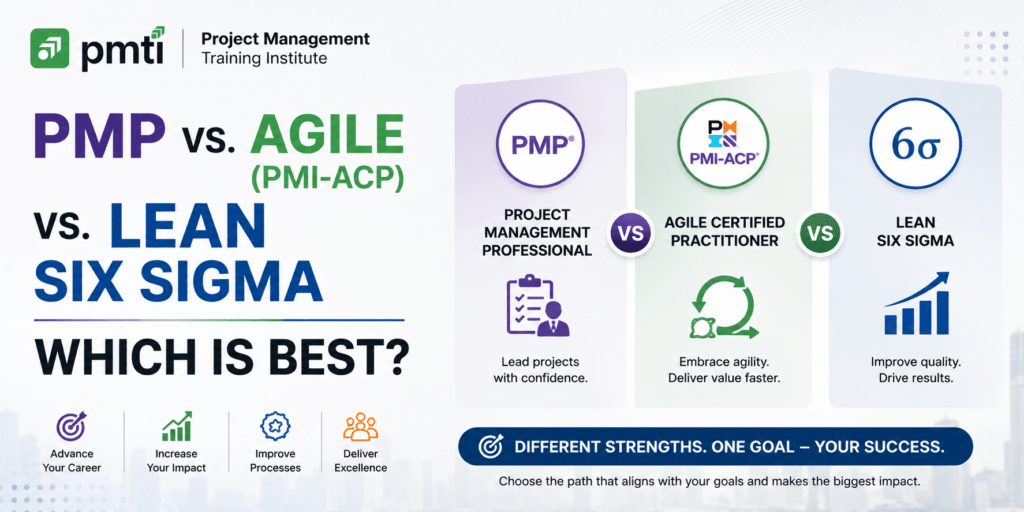
PMP vs. Agile (PMI-ACP) vs. Lean Six Sigma: Which Is Best?
PMP, PMI-ACP, and Lean Six Sigma all address different needs in the workplace. PMP certifies the project manager’s competency in managing a project from initiation to closure in all its dimensions — time, cost, risk, and stakeholder and communication management. PMI-ACP certifies competency in the management of agile and iterative project deliveries using any of the 8 frameworks. Lean Six Sigma certifies competency in the statistical approach to the sustained control of process improvement in the absence of project focus.
The main distinguishing factors are emphasis, method, and application, as well as the structure of the certification. Choosing the wrong option can lead to a waste of 3–6 months, and cost between $500 and $2,500.
PMTI is a PMI Authorized Training Partner and provides 120-question mock exams simulating the PMI-ACP exam, in PMI-ACP’s agile framework and ECO domain’s distribution, for those who have selected PMI-ACP as their credential of choice.
What Is Certified By Each Credential?

PMP provides certification for leading project delivery via predictive, agile, and hybrid methodologies. PMI-ACP provides certification for mastery of agile methodologies across various frameworks. Lean Six Sigma certification provides verification of capability to perform data-driven process improvements by means of waste and defect reduction. All three test for applied competence, and none test for rote definition.
| Attribute | PMP | PMI-ACP | Lean Six Sigma |
| Issuing body | PMI (single body) | PMI (single body) | Multiple bodies — ASQ, IASSC, Six Sigma Academy |
| Primary focus | Project delivery governance | Multi-framework agile delivery | Process efficiency and defect reduction |
| Methodology | Predictive, agile, hybrid | Agile-only (8 frameworks) | DMAIC (Define, Measure, Analyze, Improve, Control) |
| Credential levels | 1 (PMP) | 1 (PMI-ACP) | 4 (Yellow, Green, Black, Master Black Belt) |
| Global recognition | Highest — PMI in 200+ countries | High — PMI ecosystem | Variable — depends on certifying body |
| Industry application | Universal | Software, product, transformation | Manufacturing, healthcare, finance, logistics |
The first major point of difference is the issuing body structure. PMP and PMI-ACP come from PMI, a single, consistent standardized body which offers the same examination, audit, and PDU maintenance requirements. There are no certifying body protections for Lean Six Sigma, as it is mathematically founded. For this reason, there is not a single certifying body. An LSS Black Belt from IASSC is not the same credential as a Black Belt from ASQ or a corporate Six Sigma Academy, and comes with different prerequisites, examination formats, and recognition from employers. There is a risk for candidates who are unaware of which LSS certifying bodies are recognized by their target employers, as they could end up obtaining a credential that is not transferable.
How Do the Prerequisites Compare?

PMP requires the most with 36 months leading projects as well as 35 hours of training. The PMI-ACP certification requires 12 months of project management experience, 8 months working in a role with Agile, and 21 hours of training. Lean Six Sigma requirements vary by body and belt level. A Yellow Belt, for example, requires no work experience, while a Black Belt can require 2-5 years of experience.
| Criteria | PMP | PMI-ACP | LSS Green Belt | LSS Black Belt |
| Work experience | 36 months PM leadership | 12 months general PM + 8 months agile | Varies — typically 3 years | Varies — typically 3–5 years |
| Education | Secondary degree minimum | Secondary degree minimum | Varies by body | Varies by body |
| Training hours (mandatory) | 35 contact hours | 21 contact hours | Varies — typically 40–100 hrs | Varies — typically 100–200 hrs |
| Application audit risk | Yes — PMI audits % | Yes — PMI audits % | No — most bodies | No — most bodies |
| Experience verification | Supervisor sign-off | Supervisor sign-off | Project completion report | Project completion report |
PMP has the most stringent experience requirement of the three certifications. PMI-ACP requires a general PM experience and an agile experience, both of which are dual experiences. LSS does not require documented PM experience and are project based. A candidate can earn an LSS Green Belt through coursework and a single improvement project.
PMTI offers instructor-led agile training that provides the 21 contact hours that PMI requires in order to submit the ACP application. PMTI training covers all 8 frameworks and the application training requirements and incorporates live training.
How Do the Exam Formats Compare?
The PMP is the longest exam with 180 questions and 230 minutes. The PMI-ACP exam consists of 120 questions in 180 minutes. The LSS exams also differ by body and belt level. The IASSC Black Belt exam is 150 questions with a 4-hour timeframe, and the ASQ Black Belt exam is also 150 questions with a 4-hour open-book exam. All three use scenario-based questions for the advanced belts and certifications.
| Exam Criteria | PMP | PMI-ACP | LSS Black Belt (IASSC) |
| Questions | 180 | 120 | 150 |
| Duration | 230 minutes | 180 minutes | 240 minutes |
| Question format | Scenario-based situational | Scenario-based situational | Knowledge + calculation |
| Passing score | Not published (psychometric) | Not published (psychometric) | 70% |
| Open book | No | No | No (IASSC) / Yes (ASQ) |
| Attempts allowed | 3 within 12 months | 3 within 12 months | Varies by body |
| Delivery | Pearson VUE | Pearson VUE | Body-specific platform |
LSS Black Belt exams also include questions that require math, unlike the PMP or PMI-ACP exams. Candidates with project leadership and decision-making backgrounds will find PMP and PMI-ACP exams more intuitive, while candidates with strong math and LSS backgrounds find LSS exams content more intuitive. That’s why acting from a particular role may subjectively make one exam more difficult than the others.
How Do the Costs Compare?
The total cost for PMP preparation is from $900 to $3,500 and PMI-ACP is from $700 to $2,500. For LSS, Green Belt ranges from $300 to $2,000 and LSS Black Belt from $1,000 to $4,000, depending on the certifying body and training format. LSS has the widest cost range due to multiple certifying bodies without a standard price.
| Cost Component | PMP | PMI-ACP | LSS Green Belt | LSS Black Belt |
| Exam fee | $405 (member) / $555 (non-member) | $435 (member) / $495 (non-member) | $295–$450 (IASSC) | $295–$450 (IASSC) |
| Training | $400–$3,000 | $200–$2,000 | $200–$1,500 | $500–$3,500 |
| Total Initial | $900–$3,500 | $700–$2,500 | $300–$2,000 | $1,000–$4,000 |
| Renewal period | 3 years | 3 years | 3 years (IASSC) | 3 years (IASSC) |
| Renewal PDUs | 60 PDUs | 30 PDUs | Varies | Varies |
| 3-year maintenance | $60–$150 | $60 | $100–$150 | $100–$150 |
PMP has the highest renewal maintenance for 60 PDUs every 3 years. This is compared to 30 PDUs for PMI-ACP. For LSS, some certifying bodies require no renewal, meaning LSS will expire without notification. PMI’s renewal system provides proof of continued professional development, which is valued by employers from regulated industries.
The curriculum from PMTI, which is both predictive and agile, provides the 35 contact hours that PMI requires for eligibility, and also agile PM and PMI-ACP preparation for the candidates. This way, the total preparation cost for both the PMP and PMI-ACP can be optimized.
Which Certification Has The Biggest Salary Impact?
PMI’s Earning Power Survey shows PMP holders, on average, enjoy the biggest median salary premiums (33% over non-certified peers) in 21 countries. The PMI-ACP certification provides a lower median salary premium in the range of 16–23%. Lean Six Sigma Black Belt certification offers a median salary premium of 20–30% in manufacturing and healthcare sectors.
Holding a Lean Six Sigma certification in addition to the PMP offers a 19% increase over PMI-ACP certification alone.
| Certification | US Average Salary | Salary Premium versus Non-Certified | Highest-Salary Industries |
| PMP | $120,000-130,000 | 33% | Government, IT, construction, financial services |
| PMI-ACP | $115,000-125,000 | 16-23% | Technology, product, digital transformation |
| LSS Green Belt | $95,000-105,000 | 10-15% | Manufacturing, healthcare, logistics |
| LSS Black Belt | $110,500 | 19-30% | Manufacturing, healthcare, defense |
In sectors where process management impacts the quality of healthcare and patient safety, Master Black Belts earn 20-30% more than PMP certified project managers. In all other sectors, PMP and PMI-ACP certifications earn significantly more than LSS certifications.
The salary data has one important limitation — the premium is role-dependent, not certification-dependent. A PMP certification held by an individual contributor in a role has a smaller premium than the same PMP certification held by a senior program manager or a PMO Director. The role signals value; the certification signals capacity.
What Industries Appreciate Which Credential?

PMP is highly regarded across all sectors: IT, construction, healthcare, finance, government, military, and manufacturing. All these sectors include PMP in their senior project personnel requirement. PMI-ACP is mostly in demand in the sectors of technology, product development, digital transformation, and all enterprises that employ agile delivery mechanisms. The demand for LSS is largest in manufacturing, healthcare, logistics, and service operations that cater to process stability which in turn impacts quality and cost.
| Industry | PMP | PMI-ACP | LSS |
| Software and technology | High | Highest | Low |
| Construction and engineering | Highest | Low | Moderate |
| Healthcare | High | Moderate | Highest |
| Manufacturing | High | Low | Highest |
| Financial services | High | High | High |
| Government and defense | Highest | Moderate | Moderate |
| Digital transformation | High | Highest | Low |
| Logistics and operations | Moderate | Low | High |
Of the credentials being compared, the industry fit table reveals the greatest decision signal. Those working in process improvement in manufacturing or healthcare need LSS, not PMP. Those working in the delivery of software products need LSS along with PMI-ACP, which in that context is likely to be the more important credential. Those working in government contracting and construction need PMP. The industry and the job context determine the right credential. Personal choice is of little importance.
Who Should Opt for What?
Select PMP if you want to manage projects regardless of industry and need recognition from employers across the globe for program management, PMO, or director positions. Select PMI-ACP if you are in agile delivery environments and wish to have recognized competence across multiple frameworks beyond Scrum. Select LSS if you are in a role focused on continual improvement of processes, decreasing waste, or enhancing quality in operational environments.
| Candidate Profile | Best Credential | Second Credential |
| Senior PM in Any Industry | PMP | PMI-ACP |
| Agile Team Lead or Coach | PMI-ACP | PMP |
| Operations or Quality Manager | LSS Black Belt | PMP |
| Software Delivery Professional | PMI-ACP | PMP |
| Manufacturing or Healthcare Professional | LSS Black Belt | PMP |
| Career-Changer into Project Management | PMP | PMI-ACP |
The best credential is not “it depends on your goals.” The best credential is determined by the following: 1) current role (project delivery, agile delivery, or process improvement), 2) target industry (universal, tech, or manufacturing), and 3) existing experience (PMP 36-month rule, PMI-ACP > 8-months experience in agile, LSS having completed a project).
Can You Hold PMP, PMI-ACP, and LSS Simultaneously?
Yes. The tri-credential profile PMP + PMI-ACP + LSS Black Belt is held by Senior Program Managers, Agile Transformation Leads, and Operational Excellence Directors. This credentialing profile is project delivery, agile, and LSS, and is the trifecta for an Operational Leadership profile.
Most efficient order: PMP, then PMI-ACP (since 50% of the content is the same from PMP), then LSS Green Belt or Black Belt (based on the industry). The PMP holder brings predictive and hybrid methodologies to the PMI-ACP content and scenario preparation. This directly assists in reducing the time to formulate the PMI-ACP question format and integrate LSS.
Regarding training for the PMP and PMI-ACP accredited applications, PMI confirms that training from PMI-designated accredited organizations is the only training they accept. Since this is the case, selecting a training provider is the most critical decision in a multi-credential pathway.
Frequently Asked Questions: PMP, PMI-ACP, and Lean Six Sigma
What Are the Differences Between PMP, Agile, and Lean Six Sigma?
The fundamental differences lie in focus and methodology. PMP is universal project delivery governance across predictive, agile, and hybrid methodologies. PMI-ACP focuses exclusively on agile methodologies across 8 frameworks. Lean Six Sigma focuses on data-driven process improvement using the DMAIC model (Define, Measure, Analyze, Improve, Control). PMP is the broadest credential with the highest global recognition; PMI-ACP is agile-specific; LSS is operations and quality-specific.
What Career Growth Can You Expect From Each Certification in 2026?
The PMP Certification will deliver the most expansive career growth across the most industries. PMI surveys found that PMP certified project managers receive a 33% salary increase on average across the 21 countries that they surveyed, so it represents the best value project management certification. The PMI-ACP Certification provides the best value for project, product, and digital transformation roles within the technology sector. The Black Belt Lean Six Sigma Certification provides the best ROI for the manufacturing sector, as well as the healthcare and operational sectors. The best certification for career growth is the one aligned to the industry and role the candidate targets. It’s not the one that has the most holders globally.
Is Lean Six Sigma Relevant to Project Managers?
Lean Six Sigma is relevant to project managers from the perspective of two contexts. One is managing projects within manufacturing, healthcare, or operations where process efficiencies are an output or deliverable of the project. The second is incorporating process improvement rigor to a project management career within industries where the LSS Black Belt is listed as a requirement for senior positions along with PMP certification. Outside of these scenarios, the PMI-ACP certification is a more favorable option for project managers looking for a certification within the agile space than Lean Six Sigma certification — PMI-ACP offers an extension to the knowledge of agile methodologies that the PMP certification presents, while Lean Six Sigma offers an entirely different discipline centered on statistical process improvement. This requires a separate and distinct learning journey.
Can You Use the Same Training for PMP and PMI-ACP?
Yes, to an extent — the agile and hybrid methodologies referenced within the PMP’s 2021 Exam Content Outline, which comprises 50% of the PMP exam, align to the PMI-ACP exam. Therefore, a candidate who undertakes live training in agile methodologies to fulfill the PMI-ACP’s 21 contact hours will cover a portion of the content that supports the agile domain in the PMP exam. The same concept holds true for PMP training that covers agile frameworks and shorten the time of effective study for the PMI-ACP exam. The training hours will not be considered as fulfilled for both credentialing applications; however, the content will be considered the same and will allow for a reduction in preparation time for dual-credentialing of 4–6 weeks.
Does Lean Six Sigma Have a Body Like PMI?
Lean Six Sigma does not have a similar entity to PMI that represents a worldwide certifying body. The certifying bodies that offer Lean Six Sigma certifications and are most recognized are the ASQ, IASSC, and Six Sigma Academy. There are variations in prerequisites, tests, and standards for each certifying body. There are also variations in perceptions regarding the value of a Black Belt from IASSC or Black Belt from ASQ — for certain employers and for certain industries, one certifying body is more relevant than the other. In those cases, it is necessary for the candidate to find out which certifying body the relevant employers recognize the most before spending time and/or money on a Lean Six Sigma certification.
Which Certification Is Most Difficult to Achieve?
Overall, the PMP is the most difficult certification to gain. It also has the most difficult prerequisite — 36 months of documented experience as a project manager. The exam is the longest and most difficult, featuring 180 questions which must be answered in 230 minutes, and extended psychometric grading (length and type of grading process is unspecified). The PMI-ACP has a moderate level of difficulty, as it also has a dual experience prerequisite, and is based on 120 scenario questions which must be answered in 180 minutes. The Lean Six Sigma Black Belt certification has the most difficult threshold to cross due to the advanced level of statistics, including measurement systems analysis and process capability analysis — verified project management experience is not a prerequisite.
Is PMI-ACP More Desirable Than PMP for Agile Roles?
PMI-ACP is not more desirable than PMP for agile roles; it is very specific. PMP integrates agile and hybrid methodologies as 50% exam coverage, whereas PMI-ACP focuses on agile and goes deeper into 8 methodologies. PMI-ACP + PMP is the credential combination most desired for senior agile delivery roles: Director of Agile Delivery, Agile Coach, Head of Product. PMI-ACP focuses on agile frameworks. Combined with PMP, it drives achievement in delivery governance structures and frameworks. The combination of PMI-ACP + PMP is the credential combination most desired for senior agile delivery roles and, in particular, delivery governance roles.
PMTI offers 120-question, full-length, agile domain, timed practice exams and confirms PMI-ACP exam preparedness by the time the exam date is set. This constitutes performance assurance to prevent loss of the $435 exam fee.


