


What Is the Difference Between a Product Manager and a Project Manager?
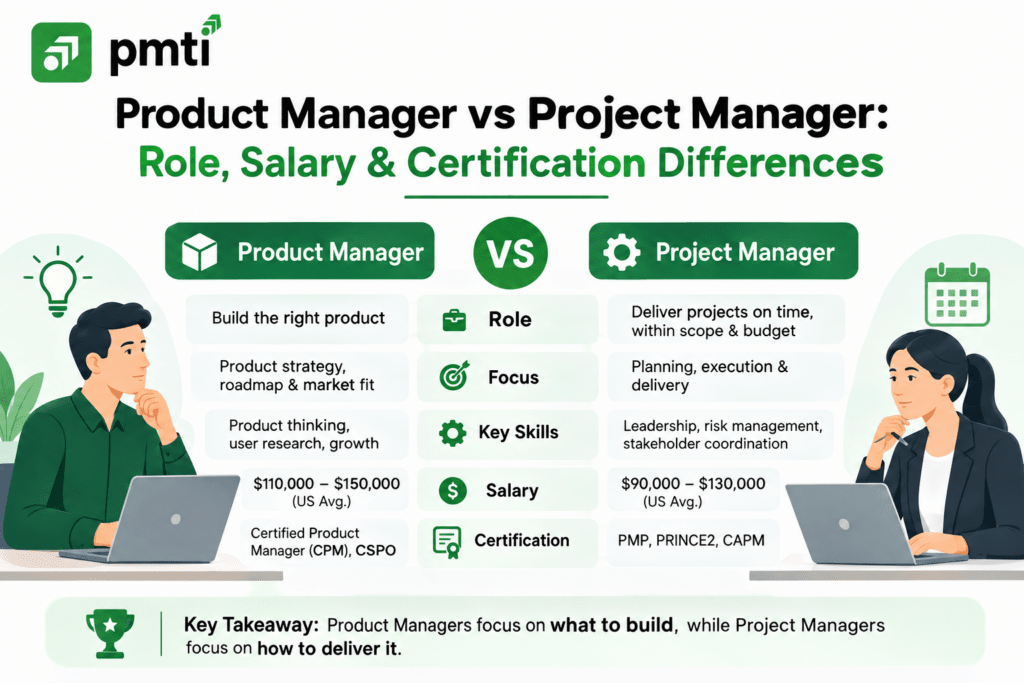
A Product Manager owns product strategy, vision, and customer needs, deciding what a team builds and why it matters to the market. A Project Manager owns execution, coordinating timelines, budgets, and resources to deliver that product on schedule.
| Product Manager | Project Manager | |
| Core question | What should we build, and why? | How do we build it, on time and on budget? |
| Time horizon | Long-term — full product lifecycle | Short-term — a defined project with a start and end date |
| Success measured by | Adoption, revenue, customer satisfaction, market fit | On-time delivery, budget adherence, scope compliance |
| Team led | Product team (design, engineering, research) | Project team (cross-functional, task-focused) |
| Reports to | Head of Product, VP Product, CPO | PMO Director, Program Manager, department head |
What Does a Product Manager Do Day to Day?

A Product Manager researches customer needs, defines the product roadmap, prioritizes the backlog, and aligns engineering and design teams around a shared vision of what the product should become.
- Research customer needs through interviews, surveys, and usage data to identify real problems worth solving.
- Define the product roadmap and translate market opportunity into a prioritized backlog.
- Prioritize features based on customer impact and business value, not just stakeholder requests.
- Communicate the product vision to engineering, design, sales, and executive stakeholders.
- Monitor competitor products and market trends to keep the roadmap relevant.
- Own the product’s profit-and-loss performance in many organizations, not just its feature set.
What Does a Project Manager Do Day to Day?
A Project Manager scopes work, builds the project timeline, allocates resources, and manages risk to deliver a defined outcome within budget and schedule constraints.
- Scope the project and break strategic goals into actionable tasks.
- Build the timeline and coordinate dependencies across the team.
- Allocate resources and manage capacity across competing priorities.
- Track progress against budget, schedule, and quality targets, and report status to stakeholders.
- Identify and mitigate risks before they delay delivery.
- Manage scope changes without letting the project drift from its original goals.
How Do Product Manager and Project Manager Salaries Compare?
Product Managers report higher average total compensation than Project Managers in most markets — commonly $130,000 to $165,000 versus roughly $100,000 to $135,000 — though the gap narrows or reverses at the senior and certified level.
Product Manager pay skews higher partly because a larger share of total compensation comes from bonus and equity, especially at tech companies, which inflates the headline average relative to base salary alone. On the Project Manager side, certification status makes a measurable difference: PMI’s own 14th edition Earning Power survey reports a median of $135,000 for PMP-certified project managers in the US, against $109,157 for non-certified peers performing similar work — roughly a 24% gap. The US Bureau of Labor Statistics puts the broader Project Manager median (certified and non-certified combined) at $100,750.
What Certifications Should a Product Manager Pursue?
Certified Scrum Product Owner (CSPO) and Professional Scrum Product Owner (PSPO) are the standard certifications for Product Managers working in Agile/Scrum environments. AIPMM’s Certified Product Manager (CPM) is the closest equivalent to an industry-wide standard for the full product lifecycle.
| Certification | Issuing Body | Format | Approx. Cost |
| CSPO | Scrum Alliance | 2-day live instructor-led course | $500–$1,500 |
| PSPO | Scrum.org | Self-paced study, exam-only | ~$200 |
| Certified Product Manager (CPM) | AIPMM | Self-study or instructor-led, 120-question proctored exam | ~$500–$1,495 |
| Pragmatic Institute Certification | Pragmatic Institute | 2–3 day courses, market-driven strategy focus | Up to ~$3,885 |
| SAFe POPM | Scaled Agile, Inc. | Course + exam | Varies by provider |
A naming collision worth flagging: AIPMM also offers a credential it calls “Product Management Professional,” which it abbreviates PMP — the same abbreviation PMI uses for Project Management Professional. These are two entirely different certifications from two different organizations, covering two different disciplines. A candidate researching “PMP for product managers” needs to confirm which body they’re looking at before enrolling.
What Certifications Should a Project Manager Pursue?
PMP remains the most widely recognized credential for Project Managers across industries, with PMI-ACP as the standard add-on for Project Managers working in Agile-heavy environments.
PMP carries the broadest cross-industry recognition and the largest documented salary premium of any project management credential. Project Managers working primarily in Agile or hybrid environments often pair it with PMI-ACP, since PMP alone covers Agile only at a survey level. Candidates ready to start can review PMTI’s PMP Certification Training program.
Can You Move From Project Manager to Product Manager (or Back)?
Yes, and it happens often in both directions. Project Managers moving into product roles typically need to build customer-research and strategic-prioritization skills; Product Managers moving into project roles typically need to build formal budget, scheduling, and risk-management discipline.
The transition is easier than switching into either role from outside project or product work entirely, since both roles share stakeholder management, cross-functional coordination, and roadmap-adjacent planning skills. What doesn’t transfer automatically: a Project Manager moving into product needs to develop comfort with ambiguous, market-driven prioritization rather than a fixed scope; a Product Manager moving into project work needs to develop the budget and schedule rigor that product roles rarely demand day to day. PMTI’s PMP Jobs & Career Paths After Certification guide covers the broader set of roles a PMP credential opens up, including hybrid product-adjacent positions.
Product Manager vs Project Manager FAQs
Can one person be both a Product Manager and a Project Manager?
Yes, especially at smaller companies or startups where headcount doesn’t support separate roles. The combined role requires both strategic prioritization skills and tactical execution discipline, which is demanding at scale but common early in a company’s growth.
Does a Product Manager need a PMP certification?
No. PMP is built for project execution — budget, schedule, scope — not product strategy. A Product Manager gains more career value from CSPO, PSPO, or AIPMM’s CPM, which map directly to product lifecycle and Agile product ownership skills.
Which role pays more, Product Manager or Project Manager?
Product Manager total compensation averages higher in most markets, largely due to bonus and equity components common in tech. PMP-certified Project Managers narrow that gap significantly compared to non-certified Project Managers, though certified PMs still trail top-end Product Manager compensation in most industries.


