


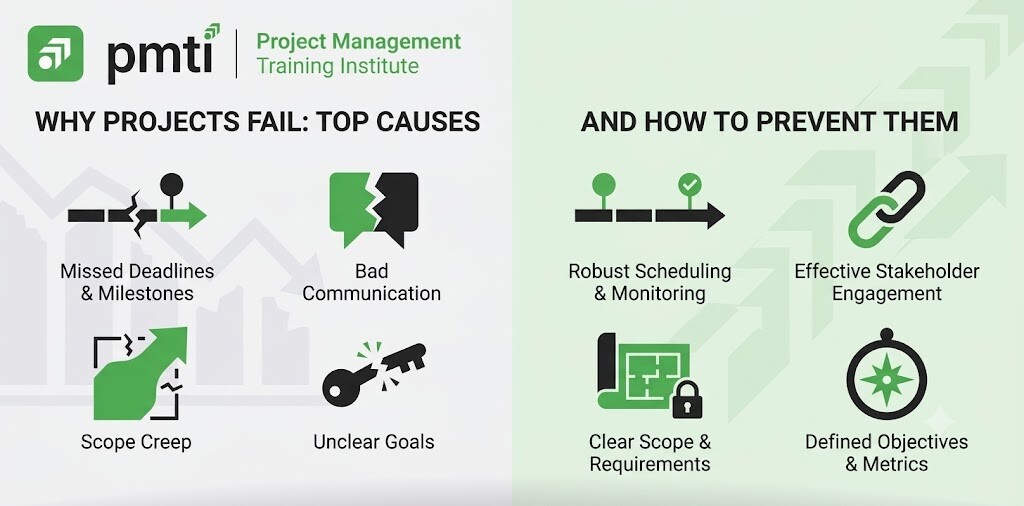

Projects fail from 8 root causes: unclear objectives, weak sponsorship, scope creep, poor estimates, unmanaged risk, stakeholder misalignment, resource shortages, and weak governance. Each cause shows an early warning signal and has a preventive control. PMI’s 2020 Pulse of the Profession reported an average of 11.4% of investment wasted through poor project performance.
What Is a Project Failure?
A project fails when it does not meet its success criteria. Failure takes 3 forms: cancellation before completion, delivery that misses scope, schedule, or cost targets, and delivery that creates no business value. The sponsor’s approved criteria decide which form applies.
| Failure Form | Definition | Example |
| Cancelled | The sponsor stops the project before delivery | A system build ends after 14 months with no release |
| Missed targets | The project delivers but misses scope, schedule, or cost | A 9-month project finishes in 14 months at 40% over budget |
| No value | The project meets its plan but the benefit never arrives | A new platform launches on time and 5% of users adopt it |
Failure depends on the criteria. A project with no recorded success criteria has no basis for judging failure, which is itself a cause. Criteria belong in the project charter and carry a metric, a target, and a date.
What Are the Top 8 Causes of Project Failure?
The top 8 causes are unclear objectives, weak sponsorship, scope creep, poor estimates, unmanaged risk, stakeholder misalignment, resource shortages, and weak governance. Each cause maps to a PMBOK 8 performance domain and has an early signal and a preventive control.
| # | Root Cause | Early Warning Signal | Preventive Control | PMBOK 8 Domain |
| 1 | Unclear objectives | Stakeholders describe the goal in different words | Measurable objectives and success criteria in the charter | Governance |
| 2 | Weak sponsorship | Sponsor misses 2 consecutive steering meetings | Named sponsor with a meeting cadence and decision rights | Governance |
| 3 | Scope creep | Change requests exceed 15% of baseline scope | Scope baseline and formal change control | Scope |
| 4 | Poor estimates | Schedule variance above 10% for 2 reporting periods | Bottom-up estimates with ranges and reserves | Schedule, Finance |
| 5 | Unmanaged risk | Open high-rated risks rise with no owner or response | Risk register, owners, and reviews each period | Risk |
| 6 | Stakeholder misalignment | Approvals stall; requirements reopen late | Stakeholder analysis and an engagement plan | Stakeholders |
| 7 | Resource shortages | Team members run above 100% allocation | Resource plan with capacity checks | Resources |
| 8 | Weak governance | Decisions wait more than 1 week for an owner | Decision rights, escalation triggers, and thresholds | Governance |
The thresholds in the table are illustrative practitioner values; the sponsor sets the real thresholds at approval.
Why Do Unclear Objectives Cause Failure?
Unclear objectives leave the team without a finish line. Fix this with 1 measurable objective and a set of success criteria approved by the sponsor before planning starts.
A goal such as “improve checkout” gives no test. “Cut average checkout time by 30% by the end of the second quarter” gives one.
Why Does Weak Sponsorship Cause Failure?
A weak sponsor stalls decisions, funding, and cross-department support. Fix this by naming a sponsor with budget authority and a fixed meeting cadence.
The sponsor removes blockers that the project manager cannot. A sponsor absent for 2 steering meetings in a row signals trouble.
Why Does Scope Creep Cause Failure?
Scope creep is the addition of work without matching changes to schedule, cost, or resources. Prevent it with a written scope baseline and a change control process that prices every request.
PMI’s Pulse of the Profession tracks scope creep as a project performance measure. The causes, examples, and controls appear in Scope Creep: Causes, Examples, and How to Prevent It.
Why Do Poor Estimates Cause Failure?
Poor estimates set targets that the work cannot meet. Prevent them with bottom-up estimates built from the work breakdown structure, expressed as ranges, with a contingency reserve.
A single-point estimate hides uncertainty. A range of 9 to 12 months tells the sponsor what the project risks.
Why Does Unmanaged Risk Cause Failure?
Unmanaged risk converts uncertainty into issues. Prevent it with a risk register that lists each risk, its probability, impact, owner, and response, reviewed every reporting period.
A risk without an owner receives no response. Review the register at each status meeting.
Why Does Stakeholder Misalignment Cause Failure?
Misaligned stakeholders reopen decisions and reject deliverables late. Prevent it with a stakeholder analysis, a communication plan, and sign-off at each phase gate.
A communication plan states what is sent, to whom, how often, and by whom.
Why Do Resource Shortages Cause Failure?
Resource shortages delay work and raise error rates. Prevent them with a resource plan that records people, equipment, and budget by period and checks allocation against capacity.
A team member allocated above 100% of capacity delivers late or poorly. Check allocation at every planning cycle.
Why Does Weak Governance Cause Failure?
Weak governance leaves decisions without an owner. Prevent it with documented decision rights, escalation triggers, and approval thresholds.
Governance answers who decides and by when. A decision that waits more than 1 week for an owner is a governance failure.
How Do You Tell That a Project Is Failing?
A failing project shows measurable warning signals: schedule or cost variance above tolerance for 2 periods, rising change requests, unowned risks, absent sponsors, and team turnover. Compare each signal with the thresholds set at approval.
| Signal | Illustrative Threshold | Cause Indicated |
| Schedule variance | Above 10% for 2 consecutive periods | Poor estimates, resource shortage |
| Cost variance | Above 10% of baseline | Poor estimates, scope creep |
| Change requests | Above 15% of baseline scope | Scope creep, unclear objectives |
| High-rated risks without an owner | 1 or more | Unmanaged risk |
| Sponsor attendance | 2 consecutive missed meetings | Weak sponsorship |
| Team turnover | Above 15% in a quarter | Resource shortage, weak governance |
Day-to-day obstacles that appear during execution, such as communication gaps and scheduling delays, are covered in 7 Common Project Management Challenges and How to Overcome Them. This page covers the root causes behind failure.
How Do You Recover a Troubled Project?
Recover a troubled project in 6 steps: pause, diagnose, re-baseline, re-engage the sponsor, prioritize scope, and report weekly. Cancel the project when the remaining cost exceeds the remaining benefit.
- Pause new work for a short review period.
- Diagnose the root cause with the 8-cause table.
- Re-baseline scope, schedule, and cost through formal change control.
- Re-engage the sponsor and agree on new decision rights.
- Prioritize scope: deliver the highest-value features first.
- Report progress weekly against the new baseline.
A stop-or-continue decision compares the cost to finish with the benefit still reachable. A project that costs $300,000 to finish and returns $200,000 in benefit stops. Money already spent does not enter the comparison.
How Do You Prevent Failure Before Execution Starts?
Prevent failure at initiating and planning. Write measurable success criteria, approve a scope baseline, estimate bottom-up, register risks, analyze stakeholders, and set governance rules. Each control closes 1 of the 8 root causes.
| Phase | Control | Root Cause Closed |
| Initiating | Project charter with objectives and success criteria | 1, 2 |
| Planning | Scope baseline and change control | 3 |
| Planning | Bottom-up estimates with reserves | 4 |
| Planning | Risk register with owners | 5 |
| Planning | Stakeholder analysis and communication plan | 6 |
| Planning | Resource plan and capacity check | 7 |
| Initiating, planning | Governance and escalation rules | 8 |
FAQs About Project Failure
What Is the Main Cause of Project Failure?
No single cause dominates. PMI’s Pulse of the Profession names engaged executive sponsors, alignment with strategy, and control of scope creep as drivers of project success, so their absence is the most common root of failure.
Do 70% of Projects Fail?
No PMI source reports a single 70% failure rate for all projects. The figure is widely repeated and, where sourced, applies to specific project types such as large transformation programs. PMI’s 2020 Pulse of the Profession reported 11.4% of investment wasted.
Failure rates vary by industry, project type, and definition of failure.
What Is the Cost of Project Failure?
PMI’s 2020 Pulse of the Profession reported that organizations waste an average of 11.4% of investment because of poor project performance. A company investing $100 million in projects loses about $11.4 million.
PMI also reported that organizations that undervalue project management see 67% more projects fail outright.
Who Is Responsible When a Project Fails?
Accountability is shared. The sponsor owns the business case and decisions. The project manager owns delivery. Governance defines who decides. A project with no named owners has no one to fail accountably.
How Does Risk Management Prevent Project Failure?
Risk management prevents failure by identifying uncertain events early, scoring probability and impact, assigning owners, and planning responses. A project that manages risk converts threats into planned actions before they become issues.
Risk management addresses the uncertainty behind 4 of the 8 root causes: estimates, scope, resources, and stakeholder support. The Project Risk Management Course(24 PDUs) from PMI Authorized Training Partner PMTI teaches how to identify, assess, and respond to these risks.


