


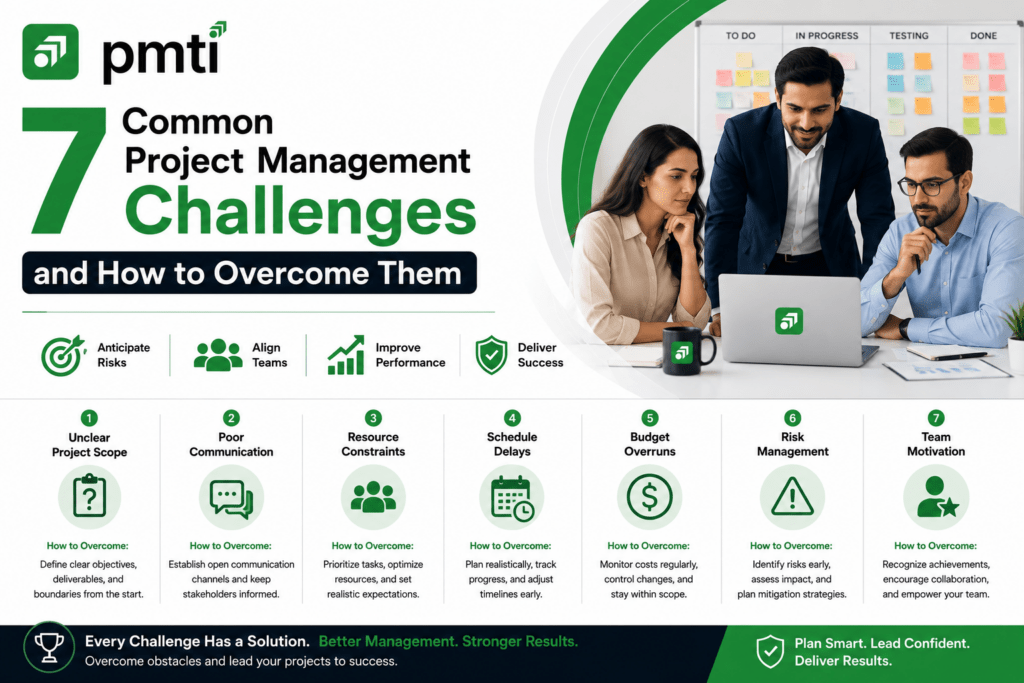
7 Common Project Management Challenges and How to Overcome Them
While industry specifics may vary, project managers generally face the same issues when starting new projects. These challenges include issues with stakeholder commitment, conflicting goals, ambiguous measures of success, inconsistent teams, scope changes, limited available resources, and even total project failure. The ability to promptly recognize and implement a specific countermeasure distinguishes a project manager who manages issues from a project manager who prevents issues from occurring.
What Are the Most Common Challenges in Project Management?
Some of the most common problems project managers face include: having to manage the introduction of new requirements and thus scope creep; the absence of stakeholder engagement; insufficient budgets and available resources; competing and unaddressed stakeholder needs; lack of definitive endpoints to measure project success; the need for collaboration across dispersed teams and even the need to rehabilitate a project from total project failure. Each problem has a unique solution, a repeatable process, or a countermeasure that can be implemented to address the problem and sustain progress on the project.
How Do You Manage Scope Creep From Changing Stakeholder Requirements?
The best way to manage scope creep is to define and formalize a set of requirements and a process for managing changes (baseline scope and change control process) prior to the initiation of work on the project. A project manager who requires formal written approval to scope change requests also protects the schedule and budget from slowly expanding scope.
- Establish a documented scope baseline and change control process before work begins.
- Require formal written approval for every scope change request.
- Communicate the schedule and budget impact of each change before implementing it.
How Do You Engage a Low-Priority or Disengaged Stakeholder?
One of the tactical management approaches for a disengaged stakeholder is the use of cadence. This includes a series of status calls that occur at a fixed interval and, more importantly, deadlines to ensure that stakeholder input is timely. If schedule risk is introduced by slow feedback or approvals by an unengaged stakeholder, then that risk should be addressed.
- Schedule recurring status calls on a fixed weekly or biweekly cadence.
- Assign specific decision deadlines to force timely stakeholder input.
- Escalate persistent unresponsiveness to a sponsor or steering committee.
How Do You Manage Resource and Budget Constraints?

Maintaining an adequate budget to manage a project is not as difficult as it may seem. When the budget is constrained, resources must be prioritized along the critical path. A continual analysis of the budget should be performed as opposed to only at formal, tracked milestones. This allows for small budget excesses to occur, which compound and are only realized at formal budget reviews.
- Prioritize work packages against the project’s critical path.
- Negotiate additional resources or schedule extensions before a shortfall becomes critical.
- Track budget variance continuously; a full breakdown of calculating and interpreting cost variance is available in Cost Variance (CV) Formula: Definition, Calculation, and PMP Exam Guide
How Do You Resolve Conflict With Stakeholders?
To resolve conflict with stakeholders, a project manager must be professional, while separating the person from the position, and continuing to defend the position. It is important for a project manager to understand that maintaining the working relationship will not be resolved by the talking points.
- Remain professional and separate the person from the position during disagreement.
- Listen fully before responding, clarifying the stakeholder’s underlying motivation.
- Escalate to a defined resolution path, such as a mediator or sponsor, when direct negotiation stalls.
How Do You Define Project Success When Expectations Differ?
For me, success gets defined by the listing of measurable goals and the recording of metrics at the beginning of every project as opposed to waiting until closure to do so. Absence of mutually agreed upon goals before project commencement will result in stakeholders and the project team ending up with opposite assessments regarding the final success of the project.
- Document specific, measurable success criteria before project work begins.
- Collect performance metrics from the project’s start, not only at closeout.
- Share progress against those metrics with stakeholders throughout execution.
How Do You Coordinate Distributed and Remote Project Teams?
Dispersed team management is accomplished by creating continuous communication flows in which all members understand the expected timeframes for answers to their communication in their respective time zones and by creating a single source of the truth for all members. Remote teams, as well as hybrid teams, have this challenge more than onsite teams, as onsite teams traditionally fill the communication gaps that remote teams have through “hallway updates.
- Establish clear communication channels and response-time expectations across time zones.
- Standardize documentation so distributed team members share a single source of truth.
- Reference a complete breakdown of remote-team strategies in Impact of Remote Work Culture in Project Management.
How Do You Respond When a Project Ends in Failure?
Failure is addressed by conducting a lessons learned review to identify the failure of delegation, communication, or planning. Failure is treated as data and not a blame game, after which the next project will be better executed.
- Conduct a structured lessons-learned review with the full project team.
- Identify the specific point where delegation, communication, or planning broke down.
- Apply documented findings to the next project’s planning phase.
How Do Project Management Challenges Appear on the PMP Exam?
The People domain on the PMP exam consists of the largest and most important of the three performance domains. This domain puts the most emphasis on the unpredictable nature of the project management process.
This domain is best represented by the numerous situational questions on the examination of what the project manager should do first upon the arrival of a conflict, change in project scope, or the introduction of a new project stakeholder. Exam questions are constructed to elicit the project management process based on a given scenario and the proper answer is not a calculation.
Sample Question 1: A stakeholder requests a significant scope addition mid-project, citing a new business need. What should the project manager do first? A) Implement the change immediately to maintain stakeholder satisfaction B) Route the request through the documented change control process C) Reject the request outright to protect the schedule D) Ignore the request until the next scheduled status meeting
Sample Question 2: A key stakeholder has been consistently slow to respond to requests for feedback and approval, creating schedule risk. What is the most effective first step? A) Escalate immediately to the stakeholder’s manager B) Remove the stakeholder from the project entirely C) Establish a recurring, scheduled touchpoint with clear deadlines for input D) Proceed with decisions without stakeholder input to avoid further delay
Sample Question 3: A project manager is in active disagreement with a client over a deliverable’s quality. What is the best immediate approach? A) Escalate to a sponsor before attempting direct discussion B) Actively listen to the client’s concerns before responding C) Defend the deliverable firmly without further discussion D) Avoid the conversation until emotions settle over several weeks
Sample Question 4: At project closeout, the client and internal team disagree on whether the project succeeded, since no success criteria were documented at the start. What should the project manager have done differently? A) Nothing; success is inherently subjective and cannot be defined in advance B) Defined and documented measurable success criteria before the project began C) Waited until closeout to determine what success should have meant D) Allowed the client to define success unilaterally after delivery
Answers: 1) B — scope changes should be routed through the documented change control process rather than implemented, rejected, or ignored ad hoc. 2) C — a scheduled, recurring touchpoint with clear deadlines directly addresses slow response patterns before escalation becomes necessary. 3) B — active listening before responding is the appropriate first step in resolving stakeholder conflict. 4) B — measurable success criteria documented before the project begins prevent exactly this kind of closeout disagreement.
Frequently Asked Questions
What Is the Most Common Cause of Project Failure?
Undefined or poorly communicated success criteria, combined with unmanaged scope changes, are among the most common causes of project failure. Both causes are preventable through documentation and change control established before execution begins, rather than corrective measures applied after problems surface.
How Do You Prevent Scope Creep?
Scope creep is prevented by establishing a documented scope baseline and requiring formal, written approval for every proposed change before it is implemented. Verbal agreements to “small” scope additions are the most common entry point for uncontrolled scope creep.
Should a Project Manager Handle Client Conflict Alone?
A project manager should attempt direct resolution first, but should escalate to a sponsor or mediator when direct negotiation fails to produce a resolution. Attempting to resolve every conflict alone, indefinitely, risks prolonging a dispute that a structured escalation path would resolve faster.
Why Is Defining Success Criteria Important Before a Project Begins?
Defining success criteria before a project begins gives the project team and stakeholders a shared, measurable standard to evaluate outcomes against, preventing the kind of closeout disagreement that arises when success is left undefined. Metrics collected from the project’s start also allow the team to course-correct mid-project rather than discovering a shortfall only at delivery.


