


Agile vs Waterfall: Differences, Pros, Cons, and How to Choose

Agile delivers working increments in short cycles and adapts to change. Waterfall delivers 1 finished product after 5 sequential phases and controls change. Choose agile for uncertain, evolving scope. Choose waterfall for fixed scope, regulated work, and high cost of change.
Agile and waterfall are the 2 poles of project delivery. Waterfall is predictive: it plans scope, schedule, and cost upfront. Agile is adaptive: it plans in short iterations and reprioritizes work every cycle. This article compares them across 12 attributes, lists 5 pros and 5 cons of each, and gives a 7-step method for choosing.
What is the difference between agile and waterfall?
Waterfall runs phases in a fixed sequence and freezes requirements at the start. Agile runs short iterations, usually 1 to 4 weeks, and revises requirements every cycle. Waterfall delivers once at the end. Agile delivers working output after every iteration.
The table below compares them across 12 attributes.
| Attribute | Waterfall | Agile |
|---|---|---|
| Approach type | Predictive, sequential | Adaptive, iterative and incremental |
| Planning | Full plan upfront | Rolling plan per iteration |
| Requirements | Fixed at the start | Evolve through a prioritized backlog |
| Phases | 5: requirements, design, implementation, testing, maintenance | Repeating cycles of plan, build, test, review |
| Delivery | 1 release at the end | Working increment every iteration |
| Customer involvement | At the start and at gates | Continuous, at every review |
| Change handling | Formal change control board | Backlog reprioritization |
| Testing | After the build, in phase 4 | Inside every iteration |
| Documentation | Extensive, written upfront | Lean, just enough |
| Team structure | Specialists in functional roles | Cross-functional self-organizing team |
| Progress tracking | Gantt chart, milestones, baselines | Burndown chart, velocity, board |
| Typical roles | Project manager, business analyst, QA lead | Product Owner, Scrum Master, Developers |
What is agile project management?
Agile project management is an adaptive approach that delivers work in short iterations and adjusts scope through continuous feedback. The Agile Manifesto (2001) defines it with 4 values and 12 principles. Scrum, Kanban, and Extreme Programming (XP) apply it.
The 4 Agile Manifesto values rank 1 side above the other:
- People and interactions over processes and tools.
- Working software over comprehensive documentation.
- Customer collaboration over contract negotiation.
- Responding to change over following a plan.
Three frameworks and methods put the values into practice:
- Scrum: a framework with 3 accountabilities (Product Owner, Scrum Master, Developers), 5 events (Sprint, Sprint Planning, Daily Scrum, Sprint Review, Sprint Retrospective), and 3 artifacts (Product Backlog, Sprint Backlog, Increment).
- Kanban: a flow method that visualizes work on a board and limits work in progress.
- Extreme Programming (XP): an engineering method built on pair programming, test-driven development, and continuous integration.
What is waterfall project management?

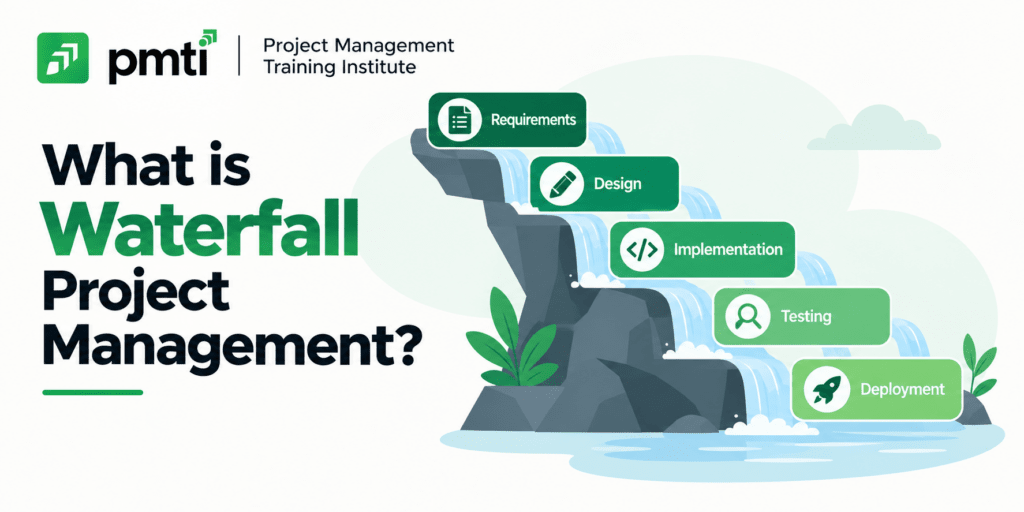
Waterfall project management is a predictive approach that completes 5 phases in strict order, with a formal approval gate after each. Scope, schedule, and cost are baselined at planning and change only through formal change control.
Waterfall teams plan with a work breakdown structure (WBS), a Gantt chart, and critical path analysis. Each phase ends with a signed deliverable. The full phase breakdown, gates, and industry examples sit in the guide to waterfall project management.
What are the pros and cons of agile?
Agile has 5 pros: adaptability, early feedback, faster time to first value, higher stakeholder engagement, and early defect detection. Agile has 5 cons: unpredictable cost and schedule, heavy communication load, weaker documentation, scope drift, and a demanding customer role.
Pros of agile:
- Adaptability: the backlog reprioritizes every iteration, so the team follows market changes.
- Early feedback: stakeholders review working output at the end of every sprint.
- Faster first value: the first increment ships weeks after kickoff, not months.
- Stakeholder engagement: the Product Owner and customers stay involved daily.
- Early defect detection: testing runs inside each iteration, so defects surface early.
Cons of agile:
- Unpredictable cost and schedule: an evolving scope makes a fixed forecast harder.
- Heavy communication load: daily meetings and reviews consume team time.
- Light documentation: thin records strain audits and staff turnover.
- Scope drift: an unmanaged backlog grows without a hard stop.
- Demanding customer role: the customer must give feedback every iteration.
What are the pros and cons of waterfall?
Waterfall has 5 pros: clear structure, predictable cost, strong documentation, simple tracking, and compliance support. Waterfall has 5 cons: rigid scope, late testing, delayed customer feedback, costly changes, and weak fit for uncertainty.
Pros of waterfall:
- Clear structure: every member knows the phase, owner, and deliverable.
- Predictable cost and timeline: a locked scope supports a fixed price and date.
- Strong documentation: specifications support audits and handoffs.
- Simple tracking: milestones and baselines show variance against plan.
- Compliance support: traceability links each requirement to its test.
Cons of waterfall:
- Rigid scope: a change after baseline needs formal approval and re-planning.
- Late testing: defects surface in phase 4, after the build.
- Delayed customer feedback: clients see working output near the end.
- Costly changes: late changes ripple through design and build work.
- Weak fit for uncertainty: products in fast-moving markets age before release.
Which is better, agile or waterfall?
Neither is better in general. Fit decides. Agile wins when requirements are uncertain and feedback is frequent. Waterfall wins when requirements are fixed, regulation is strict, and rework is expensive. The project’s profile, not the approach’s reputation, sets the answer.
Match the approach to the project type:
| Project type | Better fit | Reason |
|---|---|---|
| Mobile app or SaaS product | Agile | Requirements shift with user feedback |
| Bridge or building construction | Waterfall | Foundation work cannot iterate |
| Pharmaceutical development | Waterfall | Phased regulatory approvals |
| Marketing campaign | Agile | Channels and creative change weekly |
| Government infrastructure contract | Waterfall | Fixed-price contract and formal gates |
| Legacy system migration with a stable spec | Waterfall | Scope is known and frozen |
| New product with unknown market fit | Agile | Learning drives scope |
How do you choose between agile and waterfall?
Choose by scoring the project on 7 factors: requirement stability, cost of change, regulation, customer availability, team experience, contract type, and delivery pressure. Stable, regulated, fixed-price work scores waterfall. Uncertain, feedback-rich work scores agile.
Follow these 7 steps:
- Rate requirement stability. Fixed requirements favor waterfall. Evolving requirements favor agile.
- Estimate the cost of change. Physical or irreversible deliverables favor waterfall.
- Check regulation. Mandatory phase approvals and traceability favor waterfall.
- Confirm customer availability. A customer who reviews every 2 weeks enables agile.
- Assess team experience. A team new to agile needs coaching before it carries self-organization.
- Read the contract. A fixed-price, fixed-scope contract favors waterfall. A time-and-materials contract favors agile.
- Weigh delivery pressure. An early partial release favors agile.
Score 5 or more factors toward 1 side and adopt that approach. Mixed scores point to a hybrid.
Can you combine agile and waterfall?
Yes. A hybrid approach blends predictive planning with iterative delivery. Teams fix budget, milestones, and compliance gates upfront, then build in sprints. Hybrid is the answer when scores split between the 2 approaches.
Four hybrid patterns recur:
- Waterfall front end, agile build: requirements and design run sequentially, then sprints deliver the build.
- Agile team inside a waterfall organization: the team runs sprints while governance stays phase-gated.
- Waterfall program, agile components: the program plan stays predictive while selected teams iterate.
- Agile enterprise, waterfall hardware: software iterates while physical components follow phases.
Learn how practitioners apply these patterns in PMP with agile skills and hybrid methods.
How do agile and waterfall appear on the PMP exam?
The PMP exam tests approach selection. The 2026 exam content outline places about 60% of questions in agile and hybrid contexts. Candidates read a scenario, then choose the predictive, agile, or hybrid response that fits.
Scenario clues decide the answer. Fixed scope, a signed contract, and regulatory sign-offs point to predictive. Shifting requirements, frequent customer feedback, and a self-organizing team point to agile. Mixed clues point to hybrid.
Build the agile side of this judgment with credentialed training. The PMI-ACP certification training from Project Management Training Institute covers Scrum, Kanban, and lean practices in exam depth.


