


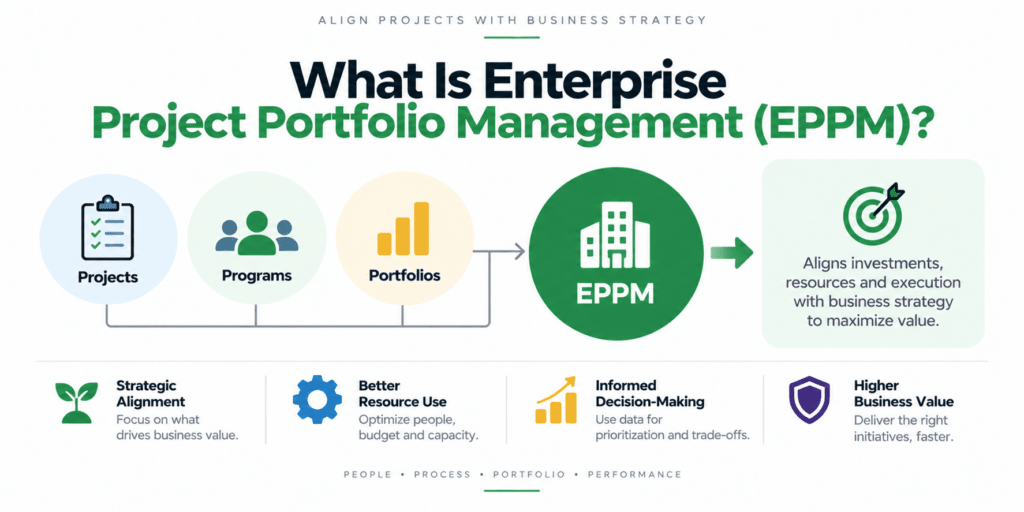
What Is Enterprise Project Portfolio Management (EPPM)?
Enterprise project portfolio management (EPPM) is the coordinated governance of multiple project portfolios across an entire organization, connecting every portfolio to the same strategic objectives, funding model, and reporting standards. EPPM builds directly on standard project portfolio management (PPM): where PPM optimizes one portfolio’s project selection and delivery, EPPM connects every portfolio in the organization under one governance model so leaders can compare investments, balance shared resources, and rebalance funding across departments rather than within just one.
What Is the Difference Between EPPM and Traditional PPM?
Traditional PPM manages project selection and delivery within one portfolio or department; EPPM extends that same discipline across every portfolio in the organization under shared governance. The 2 practices differ across 5 dimensions.
| Dimension | Project Portfolio Management (PPM) | Enterprise Project Portfolio Management (EPPM) |
| Scope | One defined area or line of business | Multiple portfolios connected under common standards |
| Focus | Aligns projects to goals within a single portfolio | Aligns every portfolio to enterprise objectives |
| Governance | A PMO or portfolio steering committee | An enterprise PMO (EPMO) enforcing standards and funding decisions |
| Resource management | Optimizes resources within one portfolio | Manages capacity across the entire enterprise |
| Visibility | Portfolio-level performance dashboards | One consolidated view of investment, capacity, and risk enterprise-wide |
PMTI founder Yad Senapathy frames the distinction directly: EPPM’s real value comes from connecting every project to the organization’s larger goals through a single view of work, resources, and cost — visibility that fragmented, portfolio-by-portfolio tracking rarely achieves on its own.
What Are the Benefits of EPPM?
EPPM delivers 6 measurable benefits by replacing fragmented, portfolio-by-portfolio tracking with one enterprise-wide governance model.
- Unifies strategy execution by aligning every portfolio and investment decision to the same enterprise objectives.
- Creates enterprise-wide visibility into spending, capacity, progress, and risk across every active portfolio at once.
- Improves investment analysis by letting leaders compare initiatives against the same criteria rather than portfolio-specific standards.
- Balances resources across portfolios, planning shared-team capacity at the enterprise level instead of leaving departments to compete for the same specialists.
- Strengthens governance and compliance through one common intake, approval, and reporting standard the whole organization follows.
- Speeds decision cycles by giving leaders consistent, comparable data to rebalance funding quickly when priorities shift.
What Challenges Do Organizations Face Implementing EPPM?
Organizations implementing EPPM face resistance to change more often than technical or software obstacles, since EPPM requires departments to give up local control over data and decision-making. According to Smartsheet’s 2025 Project and Portfolio Management Priorities Report, 92% of professionals say adapting to organizational change is difficult, and 61% of employees at large enterprises say their organization handles that change poorly. The same report found two-thirds of PPM professionals lack the data visibility needed to make confident, fast pivots.
Yad Senapathy has direct experience with this pattern: “many teams are protective of their own data and hesitant to lose control.” Building understanding starts with transparency — when departments see how shared visibility benefits the whole organization, and when leaders recognize how much effort fragmented systems waste, adoption becomes significantly easier.
3 additional challenges commonly surface during EPPM implementation:
- Getting consensus on one standardized approach across matrixed organizations with complex, inconsistent reporting structures.
- Maintaining clear EPMO authority from executive leadership to enforce portfolio-level decisions without departmental pushback.
- Reconciling inconsistent data across portfolios that track work using different cost centers, time periods, or maturity levels.
How Do You Build an EPPM Process?
Building an EPPM process requires scaling portfolio discipline from individual departments to the full organization in 6 sequential steps.
- Translate enterprise strategy into selection criteria — define the business-wide factors, such as value, cost, and risk, that determine which initiatives get funded.
- Centralize intake and triage — create one proposal channel with standardized data requirements so every portfolio submits comparable information.
- Prioritize and approve across portfolios — score every initiative against the same enterprise criteria rather than portfolio-specific standards.
- Plan capacity at the enterprise level — map shared resources and specialist skills across departments to prevent overbooking the same teams.
- Execute under standardized governance — apply consistent templates and reporting across every portfolio while still allowing individual teams to use agile, hybrid, or predictive delivery methods.
- Monitor, rebalance, and improve — track enterprise-wide KPIs continuously and reallocate funding or resources as priorities shift.
Most organizations roll out EPPM in stages over a year or more, typically starting with a single high-visibility portfolio — often IT — before standardizing practices across the rest of the enterprise.
How Do You Know if Your Organization Is Ready for EPPM?

EPPM readiness depends on whether an organization already has consistent portfolio practices, reliable performance data, and genuine executive sponsorship before attempting enterprise-wide governance. 4 readiness signals indicate an organization is prepared to move from departmental PPM to full EPPM:
- Active strategic objectives are already defined and used to guide portfolio-level decisions.
- Departments already practice some form of PPM using shared criteria, even if not yet standardized enterprise-wide.
- Senior leadership commits to enforcing shared governance and data standards, not just endorsing them.
- Existing systems can integrate or exchange data, supporting one enterprise-wide source of truth.
Organizations missing most of these signals benefit from standardizing portfolio practices and securing executive governance first, rather than attempting full EPPM before the foundation is in place.
How Does EPPM Relate to the EPMO?
The Enterprise Project Management Office (EPMO) is the governance body that runs EPPM day to day, translating enterprise strategy into portfolio selection, funding decisions, and enterprise-wide reporting. EPPM is the discipline; the EPMO is the organizational structure that executes it. For a full breakdown of how an EPMO is built and organized, see PMTI’s guide to EPMO framework and structure.
How Does EPPM Prepare You for Advanced Project Management Roles?
Project managers who understand EPPM principles — cross-portfolio prioritization, enterprise resource planning, and strategic alignment — are better positioned for program- and portfolio-level roles beyond single-project delivery. This strategic, multi-portfolio thinking builds directly on the project management foundation PMP certification establishes.
Project managers preparing to move into EPPM-supported environments can review PMP certification training as the foundational credential most enterprise-level portfolio and program roles require before considering EPPM leadership responsibility.
