


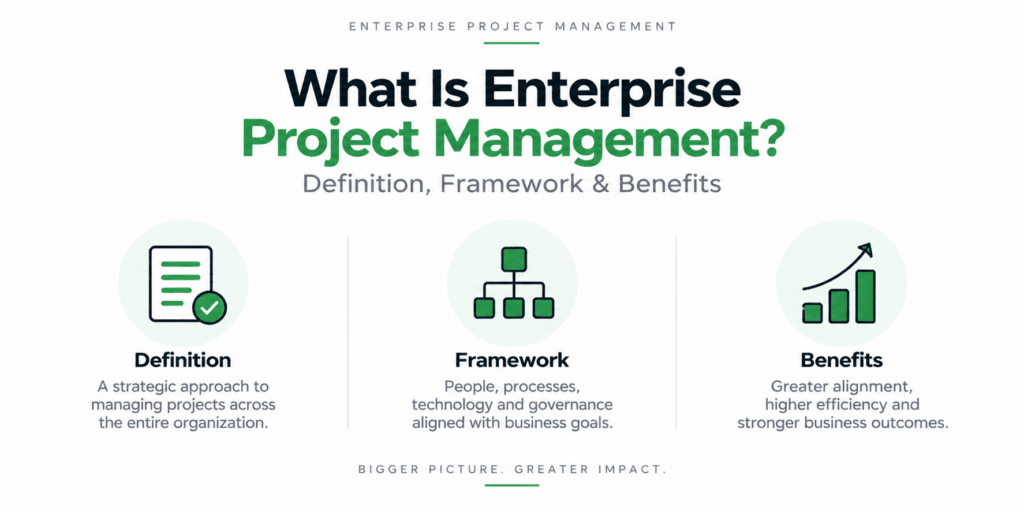
What Is Enterprise Project Management?
Enterprise project management (EPM) is the practice of managing all of an organization’s projects, programs, and portfolios as one coordinated system aligned to strategic objectives, rather than managing each project in isolation. EPM sits above individual project management: a project manager delivers one project on time and on budget, while EPM coordinates every project across the organization so their combined output advances the same strategic goals. PMI formalizes this discipline under its Organizational Project Management (OPM) standard, which defines the framework enterprises use to link strategy to execution.
What Does an Enterprise Project Manager Do?
An enterprise project manager coordinates multiple projects across departments, managing shared resources, cross-project dependencies, and strategic alignment rather than delivering a single project. Enterprise project managers typically operate from within an Enterprise Project Management Office (EPMO) and hold 5 or more years of project management experience, frequently with a PMP certification.
What Is the Difference Between a Project Manager and an Enterprise Project Manager?
A project manager delivers one project within a defined scope, schedule, and budget; an enterprise project manager coordinates an entire portfolio of interconnected projects to advance organizational strategy. The 2 roles measure success differently and operate at different organizational altitudes.
| Attribute | Project Manager | Enterprise Project Manager |
| Scope | One project with defined boundaries | Multiple interconnected projects across the organization |
| Success metric | On-time, on-budget, in-scope delivery | Strategic objective achievement and portfolio ROI |
| Timeline horizon | Weeks to months | Quarters to years |
| Resource control | Dedicated project team | Shared resources across competing priorities |
| Typical experience | 2–5 years | 5+ years, often PMP-certified |
How Does EPM Relate to PMI’s Organizational Project Management (OPM) Framework?

PMI defines Organizational Project Management (OPM) as the framework that aligns project, program, and portfolio management practices with an organization’s strategy, and enterprise project management is how organizations put that framework into daily practice. OPM formally integrates 3 management domains, each governing a different scope of work:
- Portfolio management centralizes the selection and oversight of one or more portfolios to achieve strategic objectives, bridging organizational strategy and its implementation.
- Program management coordinates related projects as a group to gain benefits unavailable from managing them individually, serving as the vehicle for organizational transformation.
- Project management delivers the individual projects that portfolios and programs contain, applying predictive, agile, or hybrid approaches as needed.
An organization’s OPM maturity — its demonstrated ability to deliver strategic outcomes predictably — determines how effectively EPM functions in practice.
What Are the Benefits of Enterprise Project Management?
Enterprise project management delivers 4 measurable benefits by replacing isolated project tracking with portfolio-wide coordination.
- Creates portfolio-wide visibility, allowing resource reassignment between understaffed and overstaffed projects and surfacing redundant initiatives before they waste budget.
- Optimizes resource allocation strategically, enabling cross-project coordination that isolated project management cannot achieve.
- Controls cost through strategic alignment, redirecting spending away from projects that don’t serve organizational goals.
- Manages risk at the portfolio level, identifying how a risk in one project could cascade into others before it does.
Organizations with a mature Project Management Office report measurably better outcomes from this coordination: PMI’s Pulse of the Profession 2026 report found organizations with a mature PMO achieve a 63% success rate managing project complexity, compared to 57% for organizations without one.
What Tools Support Enterprise Project Management?
Enterprise project management relies on portfolio-level software that centralizes reporting, resource tracking, and dependency management across every active project. 3 tool categories support EPM at scale:
- Enterprise PPM (project portfolio management) software consolidates every project into one trackable, organization-wide system.
- Portfolio dashboards give executives real-time visibility into strategic objective progress rather than individual task status.
- Integration platforms connect scheduling, budgeting, and resource systems so portfolio-level data stays current without manual reconciliation.
How Much Do Enterprise Project Managers Earn?
Enterprise Project Managers earn an average salary of $128,774 per year in the United States, based on 188 salaries reported to Glassdoor as of April 2026. Related enterprise-level roles report higher averages still: Enterprise Program Managers average $152,977, and Enterprise Project Portfolio Managers average $171,703, reflecting the added strategic scope each role carries above standard project management.
How Do You Implement Enterprise Project Management?
Implementing EPM requires 6 sequential steps that build the structure, standards, and tools an organization needs before scaling project coordination.
- Define the enterprise project manager role and how it will support existing project managers across departments.
- Establish a supporting office to manage portfolio data, track performance, and assess risk across all active projects.
- Engage executive stakeholders with clear reporting dashboards that connect project progress to strategic objectives.
- Standardize one project management methodology — predictive, agile, or hybrid — across every project team to enable consistent portfolio-level data.
- Select integrated portfolio management tools that consolidate scheduling, budgeting, and resource tracking in one system.
- Train teams on the chosen methodology and tools, then review and refine the approach on an ongoing basis.
How Does PMP Certification Prepare You for Enterprise Project Management?
PMP certification builds the project management foundation enterprise project management roles require, since most Enterprise PM positions call for demonstrated project management experience alongside PMI credentialing. The PMP curriculum’s coverage of predictive, agile, and hybrid delivery approaches directly supports the methodology standardization EPM implementation requires across a multi-project portfolio.
Project managers preparing to move into enterprise-level roles can review PMP certification training as the foundational credential most Enterprise Project Manager job postings require before considering portfolio- or program-level responsibility.
