


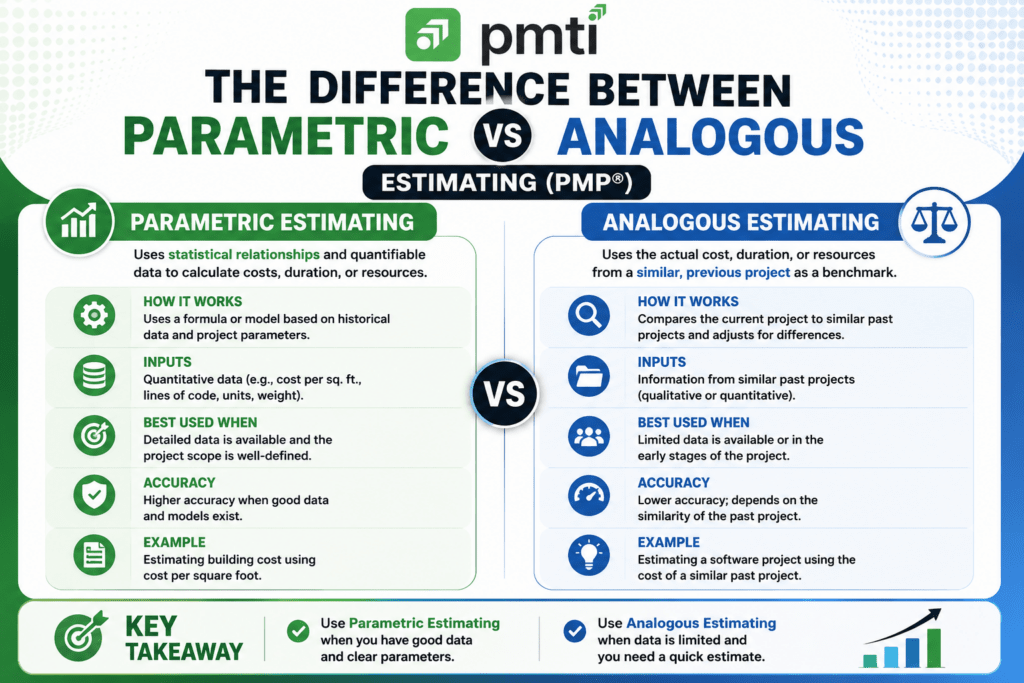

Parametric vs Analogous Estimating in Project Management: Differences, Examples, and PMP Exam Guide
Analogous estimating uses historical data from a similar past project to produce a fast, rough estimate. Parametric estimating uses a statistical relationship between historical data and measurable project variables to produce a more precise estimate. The core difference is calculation method: analogous relies on expert judgment and similarity, while parametric relies on a mathematical algorithm scaled to project units.
What Is the Difference Between Parametric and Analogous Estimating?
Parametric estimating calculates cost or duration using a statistical algorithm applied to measurable units, while analogous estimating calculates cost or duration by comparing the current project to a similar past project. Parametric produces higher accuracy because it scales mathematically to project size; analogous produces higher speed because it skips detailed data analysis.
What Is Analogous Estimating?
Analogous estimating is a technique that uses historical cost or duration data from a similar past activity or project to estimate the current one. PMI’s lexicon defines it as an estimate derived from historical data on a comparable activity, applied through expert judgment rather than statistical calculation.
- Application: projects with limited available data, or work still early in the planning phase.
- Accuracy: limited, and directly dependent on how closely the historical project matches the current one.
- Effort: low, since the technique requires no detailed data collection or statistical modeling.
A web development team is scoping a client redesign project. The team completed a similar redesign for a comparable client eight months earlier, which took 320 hours and cost $28,000. Using analogous estimating, the project manager applies these historical figures directly to the new project, adjusting only for known scope differences such as an added mobile app integration.
What Is Parametric Estimating?
Parametric estimating is a technique that uses an algorithm to calculate cost or duration based on historical data and measurable project parameters. PMI’s lexicon defines it using the same historical-data foundation as analogous estimating, but parametric applies a per-unit rate rather than a whole-project comparison.
- Application: projects where a statistical relationship between historical data and current parameters can be established, and where units scale linearly.
- Accuracy: higher than analogous estimating, since the calculation scales to the exact size of the current project.
- Effort: higher than analogous estimating, since establishing the statistical relationship requires historical data analysis.
A network installation team is running cable through a new office space. Historical data shows the team installs cabling at a rate of 12 minutes per linear foot. The new office requires 400 linear feet of cabling.
Estimated Effort = 400 feet × 12 minutes Estimated Effort = 4,800 minutes Estimated Effort = 80 hours
Parametric estimating converts a fixed historical rate directly into a project-specific total, without relying on subjective similarity judgments. Parametric and analogous outputs become the Budget at Completion and Planned Value baseline that earned value management tracks throughout project execution. What Is Earned Value in Project Management? EVM Formulas, Terms, and PMP Exam Guide</a> explains how these baseline estimates feed EVM calculations.
How Does Bottom-Up Estimating Compare to Analogous and Parametric?
Bottom-up estimating calculates a project total by estimating each individual work package separately and summing the results, producing the highest accuracy of the three techniques at the highest time cost. Unlike analogous and parametric, bottom-up estimating does not rely on historical comparison data at all.
- Application: projects with a fully decomposed work breakdown structure and enough time to estimate each component individually.
- Accuracy: the highest of the three techniques, since each work package is estimated on its own merits.
- Effort: the highest of the three techniques, since every component requires individual analysis.
A construction project manager estimating a building renovation using bottom-up estimating prices out electrical, plumbing, framing, and finishing work separately, then sums each line item into a total project estimate rather than scaling from a single historical rate or comparable project.
How Does Three-Point Estimating Fit Alongside These Techniques?
Three-point estimating adds risk-adjusted precision to any of the other techniques by combining optimistic, most likely, and pessimistic values into a single weighted estimate. Project managers frequently layer three-point estimating on top of a parametric or bottom-up estimate to account for uncertainty the base calculation does not capture.
How Do You Choose Between Analogous, Parametric, and Bottom-Up Estimating?
Choosing the correct estimating technique depends on how much historical data is available, how much time the schedule allows, and how much accuracy the situation requires. Each technique trades speed against precision in a different way.
- Select analogous estimating when a comparable past project exists and a fast, early-stage estimate is the priority.
- Select parametric estimating when a measurable, scalable relationship exists between historical data and current project units.
- Select bottom-up estimating when maximum accuracy is required and the work breakdown structure is fully defined.
- Combine parametric or analogous estimates with three-point estimating when the project carries meaningful schedule or cost uncertainty.
How Does Estimating Technique Selection Appear on the PMP Exam?
The PMP exam tests estimating techniques by describing a project scenario and requiring candidates to identify which technique best fits the described conditions. Exam questions rarely name the technique directly — recognizing it from the scenario’s data availability and accuracy requirements is the tested skill.
Sample Question 1: A project manager is estimating a new client onboarding process. No similar past project exists, but the team has fully decomposed the work into individual tasks and has time to estimate each one. Which technique should the project manager use? A) Analogous estimating B) Parametric estimating C) Bottom-up estimating D) Three-point estimating
Sample Question 2: A project manager needs a rough estimate within the hour for an executive meeting. A similar project completed last quarter took 200 hours and cost $18,000. Which technique is most appropriate? A) Bottom-up estimating B) Analogous estimating C) Parametric estimating D) Three-point estimating
Sample Question 3: A manufacturing project involves producing 500 identical units, and historical data shows a reliable per-unit production time. Which technique produces the most accurate estimate with the least effort? A) Analogous estimating B) Bottom-up estimating C) Parametric estimating D) Expert judgment alone
Sample Question 4: A project manager has a parametric estimate of 80 hours for a task but knows the task carries significant schedule risk due to a new, untested vendor. What should the project manager do next? A) Accept the parametric estimate as final B) Discard the parametric estimate and start over C) Apply three-point estimating to risk-adjust the parametric result D) Switch to bottom-up estimating exclusively
Answers: 1) C — a fully decomposed work breakdown structure with no comparable project available calls for bottom-up estimating. 2) B — a time-constrained request with a directly comparable past project calls for analogous estimating. 3) C — a reliable per-unit rate scaled across a fixed quantity is the definition of parametric estimating. 4) C — layering three-point estimating on top of a parametric estimate risk-adjusts it without discarding the underlying calculation.
Frequently Asked Questions
Is Analogous Estimating the Same as Top-Down Estimating?
Analogous estimating and top-down estimating refer to the same technique, with “top-down” describing the direction of the estimate — starting from an overall project comparison and working down to individual tasks. PMI’s formal terminology uses “analogous estimating”; “top-down” remains a common informal synonym.
Which Estimating Technique Is Most Accurate?
Bottom-up estimating produces the highest accuracy of the standard estimating techniques, since it evaluates each work package individually rather than scaling from a comparison or historical rate. That accuracy comes at the cost of significantly more time and data than analogous or parametric estimating require.
Can You Combine Analogous and Parametric Estimating on the Same Project?
Project managers routinely combine analogous and parametric estimating on the same project, using analogous estimating for early rough-order-of-magnitude figures and parametric estimating once measurable project parameters become available. The techniques are complementary rather than mutually exclusive.
Does the PMP Exam Require Calculating Parametric Estimates?
The PMP exam tests parametric estimating through both direct calculation questions and technique-selection scenarios, so candidates need to know the underlying math as well as when to apply it. A parametric question typically supplies a per-unit rate and a quantity, requiring a straightforward multiplication to reach the estimate.
Candidates who want structured, PDU-eligible practice with EVM and estimating calculations can enroll in PMTI’s Earned Value Management. Earned Schedule (24 PDUs) course.

