


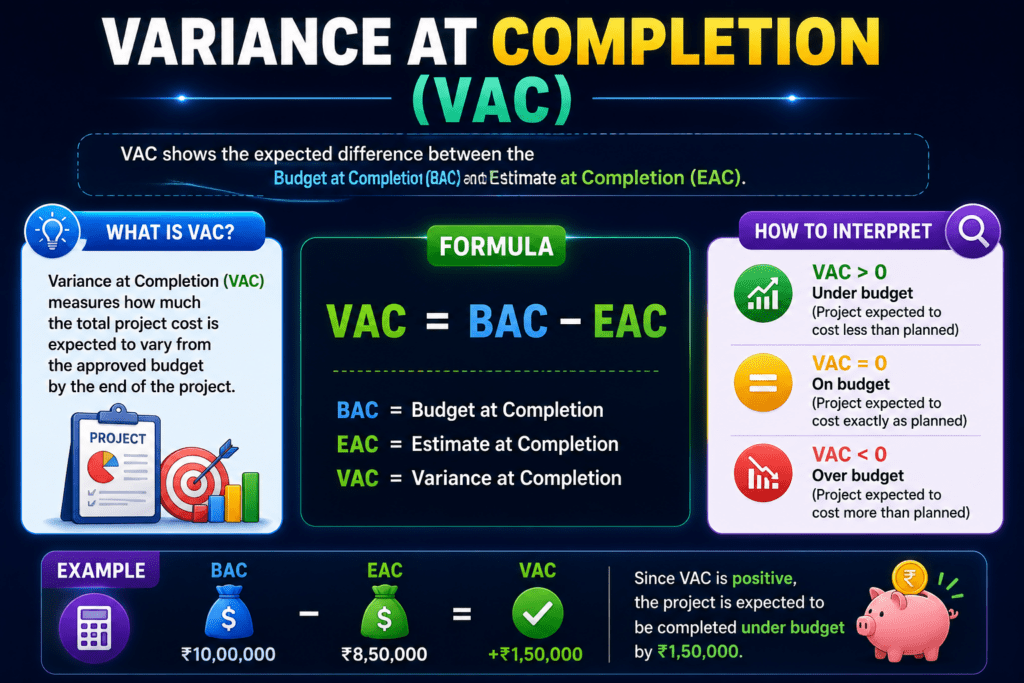
Variance at Completion (VAC) predicts the budget surplus or deficit that a project will have when it is complete. This prediction is made by subtracting the Estimated Completion from the Budget at Completion. A positive VAC means a project will finish under budget. Negative VAC means a project will finish over budget. Unlike Cost Variance as this measure looks at the current budget performance, VAC looks towards the future and predicts the outcome that has yet to be achieved.
What Is Variance at Completion (VAC)?
Variance at Completion (VAC) measures the expected budget surplus or deficit remaining at completion. This measure is equal to the original budget (the budget that was approved and sanctioned) and current cost estimate. Unlike other metrics, which emphasize the performance that has occurred, such as Cost Variance, Variance at Completion forecasts the outcome that has not yet occurred.
What Is the Variance at Completion Formula?
The Variance at Completion (VAC) is the difference between the original approved budget (BAC) and the current estimated total cost (EAC). VAC is an earned value metric measurement that does not require additional formulaic estimations.
How Do You Calculate Variance at Completion?
A project manager calculates VAC by subtracting the current Estimate at Completion from the original Budget at Completion.
A data center migration project has a BAC of $180,000. Based on current performance, the project’s EAC has been recalculated at $195,000.
VAC = $180,000 − $195,000 VAC = −$15,000
The project is forecast to finish $15,000 over its original budget.
A second project, a marketing platform rollout, has a BAC of $95,000 and a current EAC of $88,000.
VAC = $95,000 − $88,000 VAC = +$7,000
This project is forecast to finish $7,000 under its original budget.
How Do You Interpret Variance at Completion?

Generally, a positive VAC indicates that a project is suspected to finish under budget, a negative VAC indicates that the project is estimated to finish over budget, and a VAC of zero indicates that the project will finish exactly on budget. This example provides very little context, therefore, the interpretation presented here will be very straight forward.
- VAC > 0 — favorable; the project is forecast to finish under its original budget.
- VAC = 0 — the project is forecast to finish exactly on budget, indicating an accurate original estimate combined with disciplined execution.
- VAC < 0 — unfavorable; the project is forecast to finish over its original budget.
How Does VAC Relate to Cost Variance (CV)?
VAC and CV both measure budget performance, but CV measures it as of today while VAC projects what that performance will look like once the project is finished. VAC is best understood as a forward-looking projection built on top of the same underlying cost data CV uses to measure current status. Cost Variance (CV) Formula covers how to calculate and interpret that current-status figure directly.
How Does VAC Relate to BAC and EAC?
CV and VAC examine performance of the budget, however, CV does this assessment in the present, while VAC does this assessment at the completion of the project. Budget at Completion (BAC) in Project Management covers how the fixed original budget baseline is set, and Forecasting Projects in Progress With EAC: Formulas, Examples, and PMP Exam Guide covers how the current cost forecast is calculated.
What Actions Should a Project Manager Take Based on VAC?
A negative VAC calls for communicating the projected overrun to stakeholders, evaluating scope adjustments, and requesting additional funding if the original scope must be preserved; a positive VAC calls for confirming the surplus is real before reallocating it to additional work. The appropriate response depends on the sign and magnitude of the result, not a single fixed action.
- Communicate a negative VAC to stakeholders promptly, rather than waiting for it to close further.
- Evaluate scope adjustments as an option to bring a negative VAC back toward zero.
- Request additional funding through formal channels when scope must be preserved despite a negative VAC.
- Confirm a positive VAC reflects a genuine surplus, not a temporary reporting anomaly, before committing the funds elsewhere.
How Does VAC Appear on the PMP Exam?
The PMP exam tests VAC through direct calculation questions, questions requiring EAC to be derived first, and conceptual questions distinguishing VAC from Cost Variance. Exam scenarios frequently supply more data than the VAC formula actually requires, testing whether candidates can identify which figures matter.
Sample Question 1: A project has PV = $310,000, AC = $340,000, EV = $320,000, EAC = $560,000, and BAC = $600,000. What is the VAC? A) $20,000 B) $30,000 C) $40,000 D) $60,000
Sample Question 2: A project has EV = $210,000, PV = $230,000, AC = $225,000, and BAC = $300,000. The current cost variance stems from a one-time event unlikely to recur. What is the VAC? A) $0 B) −$15,000 C) $15,000 D) −$90,000
Sample Question 3: A project’s VAC is calculated at exactly $0. What does this indicate? A) The project has no remaining work B) The project is forecast to finish exactly on its original budget C) The BAC and EAC values are both incorrect D) The project cannot be measured using EVM
Sample Question 4: A stakeholder asks for the project’s current budget performance as of today, not a forecast of the final outcome. Which metric should the project manager provide instead of VAC? A) Cost Variance (CV) B) Budget at Completion (BAC) C) To-Complete Performance Index (TCPI) D) Schedule Variance (SV)
Answers: 1) C — VAC = BAC − EAC = $600,000 − $560,000 = $40,000; PV, AC, and EV are not required for this calculation. 2) B — EAC = AC + (BAC − EV) = $225,000 + ($300,000 − $210,000) = $315,000; VAC = $300,000 − $315,000 = −$15,000. 3) B — a VAC of exactly zero forecasts the project finishing precisely on its original budget. 4) A — Cost Variance measures budget performance as of the current reporting date, while VAC is a forward-looking forecast of the final outcome.
Frequently Asked Questions
Is VAC the Same as Cost Variance?
VAC and Cost Variance are similar, but distinct concepts. Cost Variance measures budget performance for the current reporting period, whereas VAC measures budget performance forecast for the completion of the project. Calling the two interchangeable is a common point of confusion, as both are expressed in dollars, and both indicate favorable or unfavorable budget status.
Can VAC Be Zero?
VAC can be equal to zero, and a VAC of zero indicates that the cost estimate for the project at completion is equal to the original approved budget. A VAC very close to zero is considered to be an accurate original estimate, and so careful project budget control is indicative of a well executed project.
What Does a Large Negative VAC Signal?
A large negative VAC means a significant budget overrun is expected, which should be communicated to stakeholders and analyzed for the possible impact of scope changes and funding requests. The more negative the value is compared to the original BAC, the more critical the discussion is.
Is VAC One of PMI’s Core EVM Formulas?
VAC is one of PMI’s core EVM formulas and is used to forecast the budget completion of the project. It is commonly used with CV, CPI, SPI, EAC, and ETC to provide a complete EVM framework.
Candidates who want structured, PDU-eligible practice calculating VAC alongside the rest of the EVM formula set can enroll in PMTI’s Earned Value Management & Earned Schedule (24 PDUs) course.


