


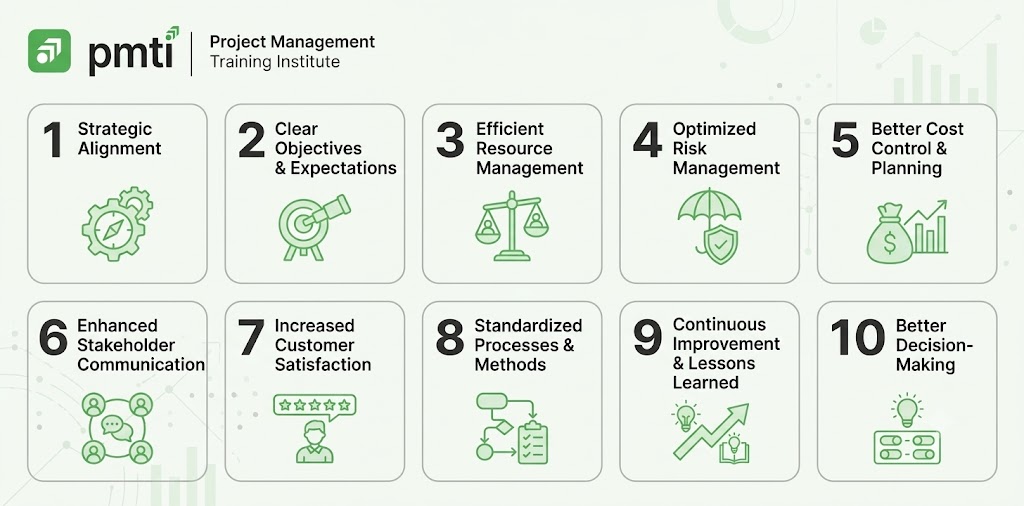

Project management is important because it converts strategy into delivered results and reduces wasted investment. PMI’s 2017 Pulse of the Profession reported $97 million wasted for every $1 billion invested because of poor project performance. Organizations with high benefits realization maturity deliver more projects on time, on budget, and to goal, and they report 35% fewer projects deemed failures.
What Is the Importance of Project Management?
The importance of project management lies in control and value. It controls scope, schedule, cost, quality, and risk so projects deliver what the organization approved. It links each project to strategy, assigns accountability, and reduces the investment lost to poor performance.
Project management has 5 sources of importance:
| # | Source | What It Does | Evidence |
| 1 | Economic scale | Organizes a large and growing share of work | 87.7 million project management roles needed by 2027 (PMI, 2017) |
| 2 | Financial protection | Cuts wasted investment | 9.7% wasted in 2017; 11.4% in 2020 (PMI Pulse) |
| 3 | Strategic delivery | Turns strategy into projects and benefits | High benefits realization maturity: 33% more projects meet goals (PMI, 2017) |
| 4 | Risk control | Finds uncertainty before it becomes an issue | Risk register, owners, responses |
| 5 | Organizational learning | Stores lessons for the next project | Lessons learned register, repository |
Each source rests on the same mechanism: a repeatable method with baselines, owners, and control points replaces individual effort and improvisation.
What Is Project Management?
Project management is the application of knowledge, skills, tools, and techniques to project activities to meet project requirements. PMBOK Guide 8th Edition organizes the discipline into 6 principles, 7 performance domains, 5 focus areas, and 40 processes.
A project is a temporary endeavor that creates a unique product, service, or result. Project management plans that endeavor, controls it, and closes it. The 7 performance domains are Governance, Scope, Schedule, Finance, Stakeholders, Resources, and Risk. The definition and the full discipline are covered in What Is Project Management? Your Key to Success.
Project management differs from operations management. Operations repeat the same output. Projects change the organization. The importance of project management grows with the amount of change an organization undertakes.
Why Does Project Management Matter to the Economy?
Project management matters to the economy because project-oriented industries employ tens of millions of people and generate trillions in output. PMI’s 2017 talent gap report projected 87.7 million project management roles by 2027 and US$20.2 trillion in project-oriented GDP contribution across 11 countries.
| Measure | Figure | Source |
| Project management-oriented roles needed by 2027 | 87.7 million | PMI, Job Growth and Talent Gap 2017-2027 |
| Growth in the project-oriented workforce through 2027 | 33%, nearly 22 million new jobs | PMI, 2017 |
| GDP contribution of project-oriented industries (11 countries) | US$20.2 trillion | PMI, 2017 |
| GDP at risk from a talent shortage over 10 years | Nearly US$208 billion | PMI, 2017 |
The figures come from a PMI-commissioned analysis by Anderson Economic Group of 11 countries. They show that organizations depend on project skills to deliver change. A shortage of skilled practitioners puts economic output at risk.
What Does Poor Project Management Cost?
Poor project management wastes a measurable share of every project dollar. PMI’s Pulse of the Profession reported $97 million per $1 billion in 2017 and an average 11.4% of investment in 2020. Organizations that undervalue project management see 67% more projects fail outright.
| PMI Pulse Edition | Finding | Meaning for $100 Million of Project Spend |
| 2017 | $97 million wasted per $1 billion invested | $9.7 million lost |
| 2020 | 11.4% of investment wasted | $11.4 million lost |
| 2020 | 67% more projects fail outright where project management is undervalued | Higher cancellation risk |
PMI also reported in 2017 that 39% of organizations named inadequate requirements gathering as the primary cause of project failure, and 30% named inadequate vision or undefined goals. Both causes belong to project management practice.
What Are the 10 Benefits of Project Management?
The 10 benefits are strategic alignment, on-time delivery, cost control, scope control, risk reduction, resource efficiency, stakeholder alignment, quality, clear accountability, and organizational learning. Each benefit has a mechanism, an artifact, and a metric.
| # | Benefit | Mechanism | PMBOK 8 Domain | Metric |
| 1 | Strategic alignment | Business case and portfolio selection | Governance | % of projects tied to a strategic goal |
| 2 | On-time delivery | Schedule baseline and critical path control | Schedule | % of projects finished on time |
| 3 | Cost control | Cost baseline and variance tracking | Finance | % of projects within budget |
| 4 | Scope control | Scope baseline and change control | Scope | Change requests per project |
| 5 | Risk reduction | Risk register with owners and responses | Risk | Open high risks; issues avoided |
| 6 | Resource efficiency | Resource plan and capacity checks | Resources | Utilization rate |
| 7 | Stakeholder alignment | Stakeholder analysis and communication plan | Stakeholders | Stakeholder satisfaction score |
| 8 | Quality | Acceptance criteria and quality assurance | Governance | Defects at acceptance |
| 9 | Clear accountability | Decision rights, roles, and escalation | Governance | Decisions closed within target days |
| 10 | Organizational learning | Lessons learned and a project archive | Governance | Lessons reused on later projects |
How Does Project Management Align Projects With Strategy?
Project management ties every project to a business case and a strategic objective before funding. Projects with no strategic link do not start. PMI’s 2017 Pulse reported that organizations with high benefits realization maturity see 33% more projects meet original goals.
A portfolio review ranks proposed projects against strategy, capacity, risk, and expected return. The sponsor funds projects in rank order. Alignment prevents 2 failures: funding work that does not serve strategy and starving work that does. The business case states the expected benefits, the cost, and the owner of each benefit.
How Does Project Management Improve On-Time Delivery?
Project management sets a schedule baseline, finds the critical path, and tracks variance each period. PMI’s 2017 Pulse reported that organizations with high benefits realization maturity complete 58% more projects on time.
The critical path method (CPM) shows which activities control the finish date. A team that tracks schedule variance weekly corrects a 1-week slip before it grows to 6 weeks. Float on the critical path reaching 0 days is the earliest warning signal.
How Does Project Management Control Cost?
Project management sets an approved budget, records a cost baseline, and compares actual spend with plan each period. PMI’s 2017 Pulse reported 43% more projects completed within budget at organizations with high benefits realization maturity.
A contingency reserve absorbs identified risks, and a management reserve absorbs unforeseen work. Earned value management (EVM) converts spend and progress into the cost performance index (CPI) and a forecast at completion. A CPI below 0.9 for 2 reporting periods triggers escalation.
How Does Project Management Control Scope?
Project management defines scope in a written baseline and routes every change through approval. PMI’s 2017 Pulse reported 34% fewer projects with scope creep at organizations with high benefits realization maturity.
Each approved change carries a cost and schedule effect, so the sponsor decides with full information. The work breakdown structure (WBS) and the requirements traceability matrix show what the project delivers and why.
How Does Project Management Reduce Risk?
Project management identifies uncertain events early, scores probability and impact, assigns owners, and plans responses. A risk register turns surprises into planned actions and sets the contingency reserve.
A project that registers 25 risks at planning and responds to the top 5 avoids issues that unmanaged projects absorb at full cost. Threat responses are escalate, avoid, transfer, mitigate, and accept. Opportunity responses are escalate, exploit, share, enhance, and accept.
How Does Project Management Improve Resource Efficiency?
Project management plans people, equipment, and budget by period and checks allocation against capacity. It prevents allocation above 100% and idle time between work packages.
A resource management plan and a RACI matrix show who does what. A resource plan reveals 3 months ahead where 2 projects compete for the same engineer. Leveling the load protects delivery dates and team health.
How Does Project Management Align Stakeholders?
Project management identifies stakeholders, records their expectations, and sets a communication plan. PMI’s 2017 Pulse named an actively engaged executive sponsor as the top driver of projects meeting original goals, cited for 62% of projects.
The power and interest grid sorts stakeholders by authority and concern. Aligned stakeholders approve deliverables faster and reopen fewer decisions. Communication grows costly with team size: 10 people form 45 communication channels, and 20 people form 190, so a communication plan removes noise.
How Does Project Management Improve Quality?
Project management defines acceptance criteria before work starts and verifies deliverables against them. Quality becomes a planned activity with a metric, not an end-of-project check.
A deliverable with the criterion “0 critical defects at acceptance” has a pass-or-fail test. Quality audits and the cost of quality (prevention, appraisal, internal failure, external failure) show where effort pays back.
How Does Project Management Create Accountability?
Project management assigns each deliverable an owner and documents decision rights and escalation paths. PMI’s 2017 Pulse reported that 81% of champion organizations have a project management office (PMO), compared with 59% of underperformers.
Clear ownership shortens decision time and removes the gaps where tasks fail. A governance structure states who decides, by what authority, and against which targets.
How Does Project Management Build Organizational Learning?
Project management records lessons learned at each phase and at closing and stores them in an archive. Later projects reuse estimates, risks, and templates, so performance improves with each project.
An organization that archives 20 completed projects holds 20 sets of real estimates for the next plan. The lessons learned register links each lesson to a cause, an impact, a recommendation, and an owner.
Who Benefits From Project Management?
Every party in a project benefits. The sponsor gets predictable returns, the customer gets accepted deliverables, the team gets clear priorities, the PMO gets comparable data, and the end user gets a product that fits the need.
| Stakeholder | Benefit | Mechanism |
| Sponsor | Predictable cost, schedule, and return | Baselines, status reports, benefits tracking |
| Customer | Deliverables that match requirements | Acceptance criteria, change control |
| Project team | Clear priorities and fewer interruptions | Scope baseline, resource plan |
| Project manager | Authority and a method | Charter, governance, decision rights |
| PMO | Comparable data across projects | Standard templates, metrics |
| End user | A product that fits the need | Requirements traceability, user acceptance |
How Do the Benefits Differ by Industry?
Every industry gains the same 10 benefits, and each emphasizes different ones. Construction gains cost and schedule control. Software gains scope control and quality. Healthcare gains risk reduction and compliance.
The examples below are illustrative.
| Industry | Typical Project | Emphasized Benefits | Example Outcome |
| Construction | Build a hospital wing | Schedule, cost, risk | Handover within 2% of budget |
| Information technology | Migrate 200 servers to the cloud | Scope, quality, risk | Cutover with 0 critical defects |
| Healthcare | Implement an electronic health record | Quality, stakeholders, risk | 95% of staff trained before go-live |
| Manufacturing | Install a new production line | Cost, schedule, resources | Line at target output in 10 months |
| Government | Build a transit line | Accountability, cost control | Milestones reported to oversight monthly |
| Nonprofit | Run a fundraising campaign | Resource efficiency | Campaign delivered with a volunteer team of 12 |
| Marketing | Launch a product campaign | Schedule, stakeholders | Launch on the fixed date |
| Finance | Build a loan platform | Governance, risk, compliance | Passed regulatory audit |
How Do Mature Organizations Perform Compared With Underperformers?
PMI’s 2017 Pulse reported that champion organizations complete 92% of projects successfully, compared with 33% for underperformers. Champions complete 80% or more of projects on time and on budget and meet original goals and business intent.
| Measure | Champions | Underperformers |
| Overall project success rate | 92% | 33% |
| Projects on time, on budget, and to goal | 80% or more | 60% or fewer |
| Organizations with a PMO | 81% | 59% |
PMI also reported that organizations with high benefits realization maturity have 35% fewer projects deemed failures. The gap shows what consistent practice is worth.
How Do Benefits Differ Across Predictive, Agile, and Hybrid Approaches?
Every delivery approach gains the benefits of project management, and each delivers them through different practices. Predictive approaches use baselines. Agile approaches use iterations and a backlog. Hybrid approaches combine both.
| Benefit | Predictive Practice | Agile Practice |
| Strategic alignment | Business case, portfolio review | Product vision, roadmap |
| On-time delivery | Critical path schedule | Time-boxed iterations, velocity |
| Scope control | Scope baseline, change control | Prioritized product backlog |
| Risk reduction | Risk register | Impediment log, early feedback |
| Stakeholder alignment | Communications plan | Sprint review with the product owner |
| Learning | Lessons learned register | Retrospective every iteration |
How Do the Benefits Map to the PMBOK 8 Performance Domains?
Each benefit maps to 1 of the 7 PMBOK 8 performance domains. Governance carries 4 benefits: alignment, quality, accountability, and learning. Schedule, Finance, Scope, Risk, Resources, and Stakeholders carry 1 each.
| Domain | Benefits Delivered | Processes |
| Governance | Strategic alignment, quality, accountability, learning | 9 |
| Scope | Scope control | 6 |
| Schedule | On-time delivery | 3 |
| Finance | Cost control | 4 |
| Stakeholders | Stakeholder alignment | 7 |
| Resources | Resource efficiency | 5 |
| Risk | Risk reduction | 6 |
The domains operate at the same time, so the benefits compound. A decision in 1 domain affects the others.
What Are the Limits of Project Management?
Project management adds effort and fails when applied rigidly. 4 limits recur: planning overhead, rigid process on small work, measurement without action, and reporting without decisions. Tailoring and clear decision rights control each limit.
| Limit | Cause | Control |
| Planning overhead | Full process on a small project | Tailor depth to size; a 2-week project runs a one-page plan |
| Rigid process | Baselines treated as fixed in a changing context | Use iterative planning and change control |
| Measurement without action | Metrics collected, thresholds not set | Set red, amber, and green thresholds at approval |
| Reporting without decisions | No decision rights | Document who decides and by when |
A project that loses these controls costs more than it returns. The benefits above hold when the method fits the project.
How Do You Measure the Value of Project Management?
Measure value with 6 metrics: on-time rate, on-budget rate, goals-met rate, scope-creep rate, wasted-investment rate, and benefits realized. Record a baseline before a program starts and compare it each year.
| Metric | Formula | Example |
| On-time rate | Projects finished on time / total projects | 42 of 60 = 70% |
| On-budget rate | Projects within budget / total projects | 39 of 60 = 65% |
| Goals-met rate | Projects meeting original goals / total projects | 45 of 60 = 75% |
| Scope-creep rate | Projects with uncontrolled scope growth / total projects | 15 of 60 = 25% |
| Wasted-investment rate | Spend lost to poor performance / total project spend | $9.7M / $100M = 9.7% |
| Benefits realized | Measured benefit / planned benefit | $1.2M / $1.5M = 80% |
The example values are illustrative. A worked return calculation: an organization spends $100 million on projects and wastes 11.4%, or $11.4 million. A project management program costing $2 million that cuts waste to 8% saves $3.4 million: a net gain of $1.4 million and a 70% return in the first year. The methods for weighing benefits against cost are covered in What Is Cost-Benefit Analysis in Project Management? Process, Tools, and Examples.
How Do You Put Project Management to Work in an Organization?
Introduce project management in 7 steps: assess current maturity, set governance, standardize templates, establish a PMO, train staff, choose tools, and review results each year. Each step produces a record and an owner.
- Assess current practice against a maturity model and record the baseline metrics.
- Set governance: decision rights, steering committee, and escalation triggers.
- Standardize the charter, plan, register, and report templates.
- Establish a PMO that owns standards, data, and the lessons repository.
- Train project managers, sponsors, and team leads on the method.
- Choose tools that hold schedules, budgets, risks, and reports in one place.
- Review the 6 value metrics each year and adjust.
An organization that follows the steps moves through 4 maturity stages: standardize, measure, control, and improve.
FAQs About the Importance and Benefits of Project Management
Is Project Management Only for Large Projects?
No. Small projects carry the same constraints of scope, schedule, and cost. The method scales: a 2-week project uses a one-page plan, and a 3-year program uses a full management plan.
What Are the 3 Main Benefits of Project Management?
The 3 main benefits are cost control, on-time delivery, and strategic alignment. These benefits decide whether a project delivers value within its approved budget and schedule.
Does Project Management Add Cost to Projects?
Project management adds planning and control effort and reduces wasted investment. PMI reports that organizations lose 9.7% to 11.4% of investment to poor performance, which exceeds the cost of structured management.
Why Do Organizations Without Project Management Fail More?
They lack baselines, owners, and control points. Without a scope baseline, requirements drift. Without a risk register, threats arrive unplanned. Without governance, decisions wait. PMI links undervaluing project management to 67% more outright failures.
Why Is Project Management Important for a Career?
Project management is a growing profession. PMI’s 2017 talent gap report projected 87.7 million project management roles by 2027 and nearly 22 million new jobs, so organizations compete for skilled practitioners.
How Do Organizations Build Project Management Maturity?
Organizations build maturity by standardizing practices, measuring results, controlling performance, and improving continuously across project, program, and portfolio levels. The Organizational Project Management Maturity Model (OPM3) assesses each domain.
Organizations that raise maturity close the gap between champions and underperformers. The Organizational Project Management Maturity Model (OPM3) Certification Online Training Course (USA & Canada) in 2026 from PMI Authorized Training Partner PMTI teaches how to assess and raise that maturity.


