


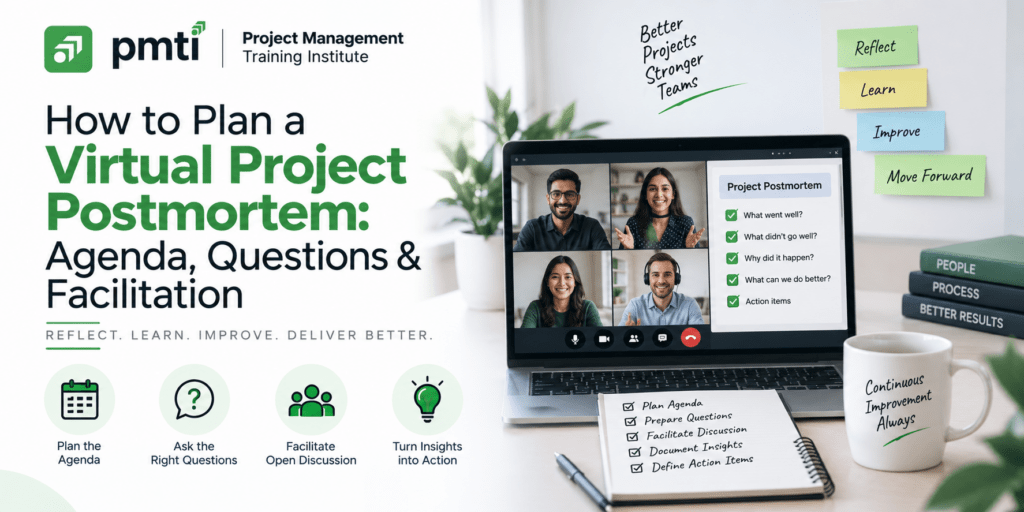
How to Plan a Virtual Project Postmortem
A virtual project postmortem is a structured, remote closing meeting where the project team reviews what worked, what failed, and what to change on future projects. The project manager schedules it before the project starts, keeps it to 1 hour or less, and runs it through 3 question types — quantitative, qualitative, and subjective — to capture both hard performance data and team sentiment before the project team disbands.
What Is a Project Postmortem?
A project postmortem is a formal review meeting held at project closure to document lessons learned from the completed work. The project manager facilitates the session, reviews project goals against actual results, and captures action items for future projects rather than assigning new tasks or deadlines.
What Is the Difference Between a Postmortem and a Retrospective?
A postmortem reviews an entire completed project once at closure; a retrospective reviews a recent work increment repeatedly throughout an active project. The postmortem belongs to predictive (Waterfall) project management; the retrospective belongs to agile delivery.
| Characteristic | Postmortem | Retrospective |
| Methodology | Predictive (Waterfall) | Agile |
| Frequency | Once, at project close | Repeats after every iteration |
| Purpose | Reviews the full project effort | Reviews the most recent iteration |
| Output | Documented lessons learned, stored for organization-wide reuse | Action items applied to the next iteration |
Agile teams running iteration-based reviews instead of a single project close should reference the agile project management guide for retrospective cadence and format.
What Is the Difference Between a Postmortem and a Premortem?

A premortem happens before the project starts and imagines failure to surface risks in advance; a postmortem happens after the project ends and reviews what actually happened. Both techniques use the same reflective format, but a premortem feeds the risk register during planning, while a postmortem feeds the lessons-learned archive during closure.
How Do You Plan a Virtual Project Postmortem?
Planning a virtual postmortem requires 6 preparation steps completed before the meeting starts, not during it.
- Schedule the postmortem during initial project planning, placing it on every team member’s calendar from day one to signal its priority.
- Limit the meeting to 1 hour or less to keep discussion focused and prevent participant fatigue.
- Build a 5-question online questionnaire, stating clearly whether responses are anonymous and how the team will use submitted answers.
- Communicate meeting expectations in advance, including camera-on requirements, management attendance, and respectful-discussion norms.
- Develop a written agenda covering project goals, metrics, results, wins, and a plan for how the team will use captured feedback.
- Test virtual meeting tools before the session, confirming chat, whiteboard, and polling features work so technical issues don’t disrupt the discussion.
Project managers running this meeting for distributed teams benefit from reviewing remote work challenges in project management before finalizing the format.
What Questions Should You Ask in a Project Postmortem?
A productive project postmortem uses 3 question types — quantitative, qualitative, and subjective — to capture performance data, delivery quality, and team sentiment in one session.
- Quantitative questions measure objective, yes-or-no outcomes: Did the project meet its deadlines? Did the team deliver every scoped deliverable? Did the project stay within budget?
- Qualitative questions evaluate delivery quality beyond the raw data: Did the work meet the standard the client expected? Did team members have the resources and support needed to complete their tasks?
- Subjective questions assess team sentiment and morale: How did team members feel about the pace and workload? What processes should the team repeat on the next project?
How Do You Facilitate a Virtual Project Postmortem?
The facilitator sets the tone for participation by staying positive, keeping discussion constructive, and giving every participant an equal opportunity to contribute. 4 facilitation practices keep the session productive:
- Incorporate questionnaire feedback into the live discussion to show the team their pre-meeting input shaped the conversation.
- Use the chat feature to draw out quieter participants who may not speak up in a full-group virtual setting.
- Follow the written agenda to keep the majority of time on wins-and-failures discussion, the most valuable and most difficult part of the session.
- Convert every action item into a specific, assignable statement rather than a vague commitment like “do better next time.”
Why Does the Project Postmortem Matter?
The project postmortem builds an organizational knowledge base that improves how future projects are planned and executed. 3 measurable outcomes result from a consistently run postmortem process:
- Reduces repeated mistakes by documenting root causes and corrective actions in a searchable, reusable format.
- Strengthens team trust by modeling a growth mindset and normalizing honest, structured reflection.
- Improves future project planning by feeding real performance data — not assumptions — into the next project’s project management plan.
Project managers formalizing this closing process as part of a broader certification path can review PMP certification training, where project closure and lessons-learned documentation are scored competencies within the Process domain.
