


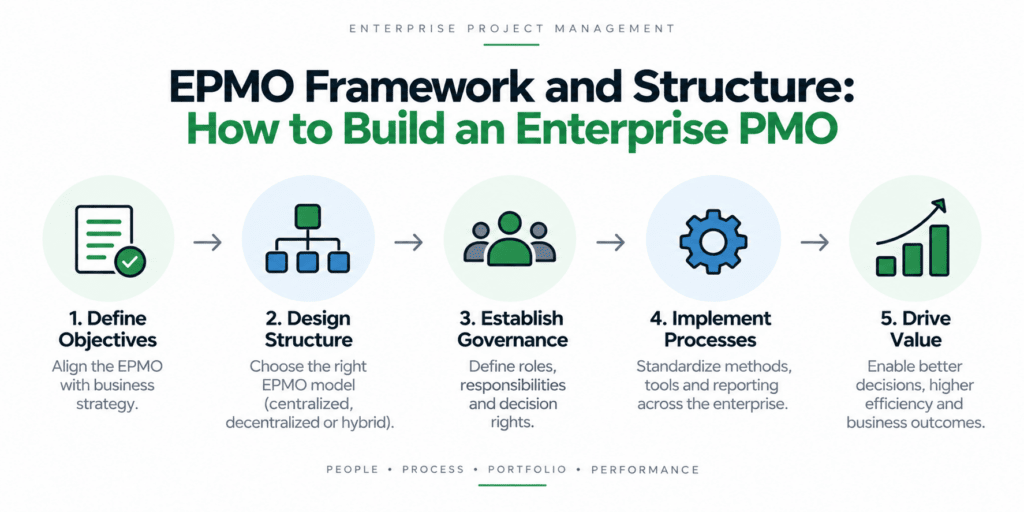
EPMO Framework and Structure
An EPMO framework defines the processes and organizational connections that link enterprise strategy to project execution, while EPMO structure defines the reporting lines and governance model that carry decisions between them. The framework determines what the EPMO connects — strategy, IT, HR, and every subordinate PMO; the structure determines how information and authority flow between those connections. Building an EPMO requires designing both deliberately, since a framework without a defined structure has no path to enforce it, and a structure without a complete framework has nothing substantive to govern.
What Is an EPMO?
An Enterprise Project Management Office (EPMO) is the centralized governance function that aligns every project, program, and portfolio management office in an organization to a single enterprise strategy. The EPMO sits above departmental PMOs, connecting decision-makers across the organization rather than managing individual project work directly.
What Is the Difference Between an EPMO and a PMO?
An EPMO governs strategy execution at the enterprise level; a PMO governs project delivery consistency at the department or portfolio level. The 2 offices differ across 3 dimensions.
| Attribute | EPMO | PMO |
| Scale | Project selection driven by enterprise strategic alignment | Project management operations within a department or portfolio |
| Focus | Meeting enterprise financial and strategic goals | Consistency of project management tools and practices |
| Reporting structure | Reports to C-suite executives and top decision-makers | Reports to mid-level portfolio or project management leadership |
What Are the Core Components of an EPMO Framework?
An EPMO framework connects 8 organizational domains, and an EPMO that omits any of these connections cannot fully activate enterprise strategy. A business analyst typically evaluates historical and current process data across these domains before an organization finalizes its framework design:
- Strategy office and executive leadership — sets the enterprise direction the EPMO translates into portfolio priorities.
- Information technology department — supplies the systems and data infrastructure the EPMO uses for enterprise-wide reporting.
- Human resources processes and resources — supports staffing decisions that affect resource allocation across the portfolio.
- Program and project management offices — execute the work the EPMO coordinates and monitors.
- Portfolio management office or leadership — selects and sequences the projects the EPMO governs.
- Organizational culture — shapes how readily teams adopt EPMO-driven standards and reporting.
- Corporate policy and governance team — defines the compliance boundaries the EPMO framework must operate within.
- Senior enterprise leadership — provides the executive sponsorship that gives EPMO decisions enforceable authority.
What Are the Common EPMO Structure Models?

Every EPMO structure requires a direct, unambiguous reporting line to senior leadership, regardless of whether the EPMO leader sits in the C-suite directly or reports to it. 2 structural patterns appear most often in practice:
- Direct C-suite structure: The EPMO leader holds a C-suite title and sits on the executive team, giving EPMO decisions immediate executive weight.
- Reporting-line structure: The EPMO leader reports directly to a C-suite executive, preserving a clear enterprise-to-project connection without requiring a dedicated executive seat.
In both models, project management flows up through enterprise project management to the C-suite without an intermediate layer that could dilute strategic alignment. The specific job titles, team composition, and management layers vary by organization, but the direct connection between project-level work and enterprise leadership must remain intact in every structure.
Why Does an EPMO Improve Project Success Rates?
Organizations with a mature Project Management Office that actively connects strategy to execution report measurably higher project success rates than organizations without one. PMI’s Pulse of the Profession 2026 report found that organizations with a mature PMO achieve a 63% success rate managing project complexity, compared to 57% for organizations without a mature PMO — and mature-PMO organizations use structured frameworks and secure sponsor alignment at initiation significantly more often than their less-mature counterparts.
This governance effect is consistent with what practitioners report directly: PMTI founder Yad Senapathy has noted that the real value of enterprise-level portfolio governance comes from connecting every project to the organization’s broader goals through one unified view of work, resources, and cost — visibility that fragmented, department-level project tracking rarely achieves on its own.
What Are the Roles and Responsibilities of an EPMO?
An EPMO is typically led by a C-suite executive or a leader reporting directly to senior leadership, with responsibilities centered on enterprise-wide analysis, forecasting, and governance rather than day-to-day project delivery. Core EPMO responsibilities include:
- Analyzing collated project budgetary and spending reports across the enterprise.
- Forecasting project success and failure rates across the full portfolio.
- Maximizing vendor contracts and enterprise-level agreements.
- Setting performance standards for enterprise-wide key performance indicators.
- Developing enterprise-level action plans from lessons learned and best practices.
- Adjusting resource allocation to respond to market or customer changes.
How Does PMP Certification Prepare Project Managers for EPMO Environments?
PMP certification builds the portfolio-aware project management foundation professionals need to operate effectively inside an EPMO structure, since EPMO environments require project managers to connect their individual project decisions to enterprise-level strategy. Project managers advancing into EPMO-supported organizations benefit from formal training in exactly this kind of strategic alignment.
Project managers preparing for roles within an EPMO structure can review PMP certification training, which covers the organizational and stakeholder alignment skills EPMO environments require beyond single-project delivery.
