


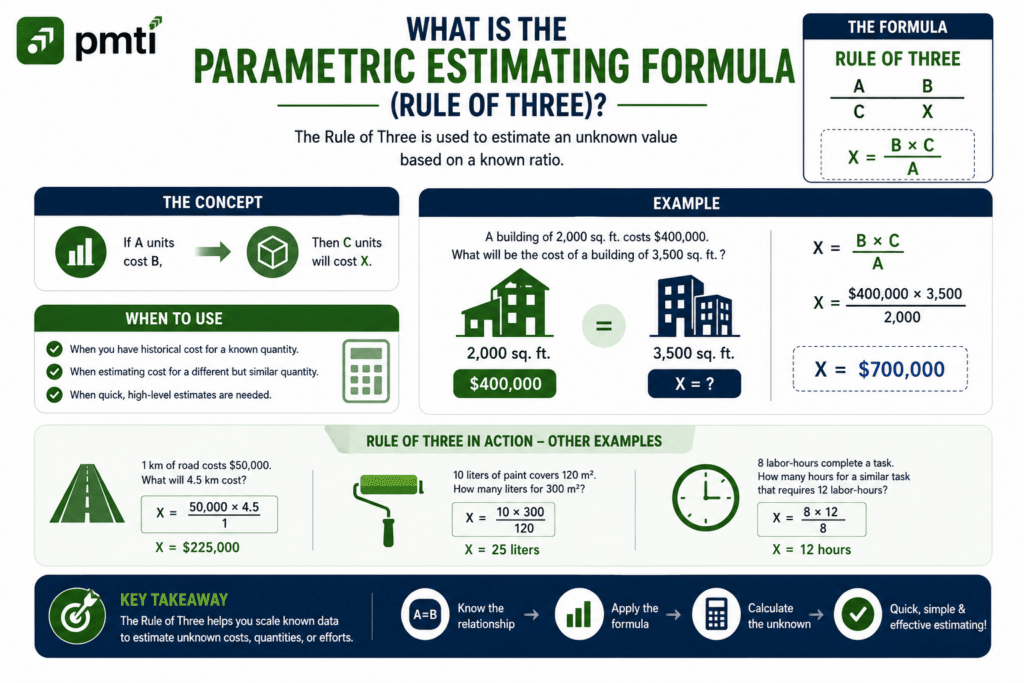
A data-entry team historically processed 500 records in 8 hours. The current project requires processing 1,200 records.
E = 8 × (1,200 / 500) E = 8 × 2.4 E = 19.2 hours
The estimate scales the historical 8-hour rate proportionally to the larger current workload, producing a 19.2-hour estimate without re-deriving the underlying process from scratch.
What Are Deterministic and Probabilistic Parametric Estimates?

A deterministic estimate would be a single value invoked by direct proportional scaling. A probabilistic estimate would be a range of values defined as optimistic, most likely, and pessimistic. As previously described, a deterministic estimate would be rule-of-three calculation; a probabilistic estimate would be the same rule-of-three calculation supplemented by both the optimistic and pessimistic scaling factors.
- Deterministic estimate — a single number, calculated directly from the parametric scaling formula.
- Probabilistic estimate — a range of values reflecting the probability of different outcomes, structured around optimistic, most likely, and pessimistic scenarios.
A probabilistic parametric estimate follows the same weighting logic used in three-point estimating, layering optimistic and pessimistic scaling factors around the deterministic rule-of-three result instead of relying on a single fixed multiplier. What Is the PERT Formula in Project Management covers the weighted-average calculation this probabilistic approach is modeled on.
How Does the Parametric Formula’s Linearity Assumption Create Risk?
Rule-of-three scaling is one of nearly 30 formulas candidates need for the quantitative portion of the exam. How to Learn and Memorize the PMP Calculation Formulas? 30 Formulas (& Examples) to Know for PMP Exam 2026 covers the full formula set, including EVM, schedule, and probability calculations alongside estimating.
How Does the Parametric Formula Appear on the PMP Exam?
The PMP exam tests the parametric formula through direct scaling calculations.The PMP exam tests the parametric formula through direct scaling calculations, in addition to the technique-selection scenarios covered in the main Parametric vs Analogous Estimating in Project Management: Differences, Examples, and PMP Exam Guide. Candidates should be prepared to apply the rule-of-three formula directly, not only recognize when parametric estimating is the appropriate technique.
Sample Question 1
A team historically completed 10 similar features in 40 hours. The current project requires 25 similar features. Using parametric estimating, what is the estimated duration? A) 62.5 hours B) 100 hours C) 16 hours D) 40 hours
Sample Question 2
A past project cost $150,000 for 3,000 square feet of construction. The current project covers 4,500 square feet, with materials and labor rates assumed constant. What is the parametric cost estimate? A) $200,000 B) $225,000 C) $100,000 D) $450,000
Sample Question 3
A project manager applies the standard parametric rule-of-three formula to a project whose actual cost relationship is not linear at larger scales. What risk does this create? A) None, since the formula always produces an accurate result B) The estimate may be significantly inaccurate at scales far from the historical data point C) The estimate will always be too low D) The formula automatically adjusts for non-linear relationships
Answers: 1) B — E = 40 × (25 / 10) = 40 × 2.5 = 100 hours. 2) B — E = $150,000 × (4,500 / 3,000) = $150,000 × 1.5 = $225,000. 3) B — the formula assumes proportional scaling, which can significantly misstate the estimate once the current project’s scale departs from the linear relationship observed in the historical data.


